The Key to Being Fast

The following article written by Michael Boyle stresses the importance of the first 10 yards when it comes to being a faster athlete.

Does It All Come Down to the First Ten Yards?

Michael Boyle www.strengthcoach.com

I have always been a ten yard dash proponent. When we test speed, regardless of sport we test the ten yard dash. In fact, I wrote an article previously that questioned whether we really ever tested speed in most team sports. If we choose to be specific, what we really evaluate with tests like the 40 yard dash is acceleration. The best sprinters in the world accelerate for up to sixty meters. That means that each ten yard split continues to get lower up to sixty meters in a world-class sprint race. A forty yard dash is a test of acceleration ability, not speed if we want to get our physics right.

The only athletes who actually ever run a forty yard dash are my NFL Combine or Pro Day athletes. Even these athletes only run the forty at the actual workouts. We never run a forty in training. In fact, over eighty percent of our training is done for ten yards, working to increase power and decrease steps. Less than twenty percent is done for 15-20 yards. In fact in over twenty years of training athletes for the NFL Combine I have never had an athlete run a forty yard dash prior to being tested by a pro scout. In spite of this, or perhaps because of this, my athletes have routinely tested well at the NFL Combine. Numerous years we have had the fastest athlete at a given position. My hesitance to run a forty prior to the Combine or the Pro day was based on a simple concept. If you are injured you can’t run the forty on the day that really matters. In the NFL evaluation process injuries at the wrong time can be career killers.

One problem arises in this process. Athletes want to know what they will run in the 40. In order to increase the ability to project 40 yard dash times from ten yard dash times I have been closely studying the segmental breakdowns of the forty yard dash from past NFL Combines to see if there was discernable pattern. I analyzed the data to see if there was a consistent formula that could be applied. The results were surprising.

It is important to clarify that initially the ten yard dash was the focus of our training primarily because the most frequent injury seen in athletes doing Combine or Pro Day prep work is a hamstring strain. In fact hamstring strains are the most consistent injury problem seen in sprinters. These hamstring strains are almost always the result of running repeat forty yard dashes in preparation for the testing. Curiously enough I have never seen a strain occur in a ten yard dash. The 10 yd dash is a great test that is close to100% safe. However, athletes being evaluated still need to run the 40 or in the case of baseball, the sixty.

In addition to the obvious injury prevention/ reduction/ avoidance angle, we have always concentrated on the 10 yard dash for the simple reason that the first ten yard segment, the start if you will, is the easiest area to improve. The first ten yard segment, although equal in length to each following ten yard segment takes more than 1.5 times as long to run. This may seem obvious as this is the “zero to sixty phase” of the vaunted forty yard dash. However to really understand the significance it is important to look at some data.

Below is a comparison of two athletes from the 2003 NFL Combine in the forty yard dash. Athlete 1 is 188 lbs. and ran a very respectable 4.59 in the forty yard dash. Athlete 2 is 236 lbs. and ran a 4.70, also a respectable time for a 236 lb athlete. The data gets significantly more interesting when broken down into ten yard segments:

Athlete 1: 10 yard (1.59) 10-20 (1.06) 20 yard (2.65) 20-40 (1.94) 40 yard 4.59

Athlete 2: 10 yard (1.70) 10-20 (1.05) 20 yard (2.75) 20-40 (1.95) 40 yard 4.70

When looking at the data one thing immediately jumps out. Both athletes ran from 10-20, 20-40 and 10-40 in nearly identical times. In fact athlete 1 obtained the entire differential in the times ( .11) during the first ten yard segment. Athlete 1 may in fact not be faster, he simply accelerates better. His “speed” is no greater, however his initial acceleration is significantly better. This graphically demonstrates how critical the initial rate of acceleration was in the race. Athlete 1 obviously has less inertia to overcome and as a result accelerates faster but, this faster initial acceleration corresponds exactly to the difference in forty yard dash times.

Two important things to note. One, this definitely reinforces my feeling about the importance of the start and of the first ten yard segment. Two, the result reinforces the importance of strength development in improving forty yard dash performance.

Many of you will say that this is a generalization. In fact, it is a generalization based on common sense. Smaller athletes with exceptional acceleration have run as low as 2.8 from 10-40 while exceptionally large athletes ( 300+) were show to run a high as 3.4. However these were extreme cases. In general to estimate 40 yd dash times from 10 yard dash times you can do the following:

For athletes under 200 lbs. assume a low of 2.8 seconds and a high of 3.0 seconds added to the 10 time.

For athletes from 200-250 you can add 3.0 to 3.2 seconds to the 10

For athletes 250-350 you can add 3.0 to 3.4 seconds to the 10.

In any case, the data clearly shows that working on the initial ten yard segment of the forty yard dash is both the safest and the fastest route to lowering your forty time.
In-Season Training

Why Train In-Season:

When it comes to an athlete’s annual training program there are three important time periods to consider:

1. Off-Season: Time period from the end of the athlete’s competitive season all the way up to their pre-season.
2. Pre-Season: 4-6 weeks leading up to the athlete’s competitive season.
3. In-Season: The athlete’s competitive season.

Given that there are 52 weeks in a year, you want to guarantee that your athlete will get the most out of each training session in order to peak their performance during the season. Training during all 3 phases is crucial to take advantage of an athlete’s genetic potential. Throughout my experience working in the college and private sector I have generally seen a strong emphasis on training when it comes to the off-season and the pre-season. General knowledge tells athletes that they need to gain strength and explosiveness to be successful in their sport season. These phases are very important, but they seem to take precedence over in-season training. With the main concern being that athletes don’t have enough time during the day with school and practice, they are choosing to skip in-season training all together.

Why This Is Bad…..

A great strength coach will know how to properly peak performance in athletes. They should be fine tuned machines right before the season. Right before their season they should not only be at their strongest, but they should be more explosive than they have ever been. It is at this point that most athletes choose to discontinue their training for the reasons previously mentioned. This is where athletes are doing themselves a disservice. They will lose the adaptations that were gained from training. Power and explosiveness can decline as quickly as a few days, while losses in strength can be seen within 3 to 4 weeks. With sport seasons being as long as 3 to 4 months the changes that will take place with a lack of training will have a direct correlation to their performance on the field. They will be weaker, their mobility and movement will decrease in efficiency, and their overall rate of force development (power) will be much lower.

How To Train In-Season

When it comes to in-season training the 2 days a week model always works best with one day focusing on strength and the second day focusing on speed and moving the bar fast. Sample exercises for day 1 might focus around strength compound movements such as the squat or the bench press, while the 2nd day is focused on explosive exercises like the clean or the snatch. Every sport season has a different schedule, but the strength day should be performed further away from competition while the explosive day can be performed closer to the time of competition. The strength day should always be performed as soon as possible after the game. The reason behind this is to not only aid in active recovery from the game, but to also get in the higher intensity lift further away from the next competition. The dynamic or power lift is best performed later in the week due to the fact that this lift is less taxing on the central nervous system. The focus of “moving the bar fast” is to help maintain the power and explosiveness built in the off-season.

The following sample weeks show what a typical week might look like for an in-season sport.

Football
Sunday Monday Tuesday Wednesday Thursday Friday Saturday
Speed Day Competition Strength Day
Basketball
Sunday Monday Tuesday Wednesday Thursday Friday Saturday
Speed Day Competition Competition Strength Day
Track and Field
Sunday Monday Tuesday Wednesday Thursday Friday Saturday
Strength Day   Speed Day   Competition Competition

These are just a few examples of what a typical schedule might look like in-season for different sports. Every sport has a very different schedule that is constantly changing. Ideally you would get in 2 days every single week, but it doesn’t always work that way. Some weeks only one session might be all you are able to do, and as a strength and conditioning coach I am constantly adjusting and adapting to meet the needs of my athletes.

The never-ending goal is to keep building progress from the previous year so athletes are never moving backwards. With a typical college career being 4 to 5 years, ideally an athlete wants to be their strongest in that final season. The charts below show how a typical athlete might progress over a 3 year span if they are training in-season versus if they do not train in-season. You can see from the in-season chart that the bigger increases are made in the off-season while small to no increases are seen in-season. This may seem counter-productive but this is exactly what you want. At the end of each season you want your strength to be at or around what it was at the beginning of the season. It is hard to add a lot of strength in season, but if you don’t train at all your strength will decrease dramatically. You can see this in the non in-season training graph because the athlete is building off a lower base than he started with. Whereas if you train consistently throughout the in-season you will be building off of a stronger base each off-season. The goal is to never regress, but to consistently move forward.

Check this graph out to see the difference in strength levels when you train in-season:  training graph


Riverside lacrosse standout Taylor Musa named Viva Loudoun Athlete of the Month

Leesburg, VA (June 15, 2017) – Please join us in congratulating Riverside’s Taylor Musa as the May 2017 Performance Edge/Viva Loudoun Athlete of the Month!

“To be athlete of the month, that’s really special,” Musa said, “there’s obviously a lot of great athletes in a lot of different sports, and I’m honored I was able to receive this, it will be one of the things I remember for years to come.”

Taylor Musa helped Riverside win the 2017 Virginia 4A Boys Lacrosse State Championship. (Photo © Aaron Wyche)

The sophomore attacker had an outstanding season with the Rams, finishing the year with 84 goals and 38 assists, putting his scoring average up to an incredible 4.2 goals per game over the 20-game season. He scored at least one goal in every game the entire year.

Thanks in large part to his dominant performances, the Rams went a perfect 20-0 en route to winning the Virginia 4A State Championship in just their second year as a school. They defeated E.C. Glass by a count of 8-6 on June 10 in Salem, Va. to bring the title back to Leesburg, and Musa contributed one goal and one assist to the effort.

“That was definitely one of the best feelings of my life so far,” Musa said, “just the fact that many of our seniors made the choice to come over, that was really special for all of our underclassmen, that was a big step to come over and help out our program, taking a chance on us and the coaches.”

The highlight of Musa’s triumphant sophomore campaign came in the state semi-finals on June 6 when he scored the game-winner in overtime against Midlothian to propel the team to the state championship. He scored five of the team’s 11 goals in that contest, showing he is only an underclassman by name, not ability.

Musa had an impressive stretch in the month of May, totaling 27 goals in just five games with an average of 5.4 goals per outing. He also set his high school career high with eight goals against Loudoun County on May 22 in a 15-3 victory.

“We went into the playoffs, it was big competition, and I’d like to say that I tried to rise to the occasion and luckily I was able to do so,” he said.

Taylor Musa, 2017 All-Region 4A North Boys Lacrosse Player of the Year (Photo © Chas Sumser)

With all of these remarkable stats, Musa has earned several post-season individual recognitions. He was named the 4A North Region Player of the Year, Co-Player of the Year in the Dulles West Conference, and was a Washington Post All-Met honorable mention.

He credits a great deal of his success to his teammates and to his coach, Nick Worek, and knows his personal accomplishments would be impossible without the supporting cast.

“Our coaches implement a system that allows us to use our lacrosse IQ,” Musa said, “a lot of our players have been playing together since we were young so we’ve really built a lot of team chemistry, so Coach Worek gives us the freedom to make our own plays all within a system. And I really appreciate my teammates, I can’t do what I do without them.”

Worek also thinks highly of his young, star player and is very impressed by his versatility.
“He is a ‘do-it-all’ attack man,” Worek said. “He can dodge, shoot from the outside, finish inside, he has great vision and is relentless on the ride and ground balls. Taylor is one of the most competitive kids I have coached.”

Musa has two more years in Leesburg to build on his high school legacy before moving on to Colgate University in Hamilton, N.Y., where he has already committed to play lacrosse.

“When I visited Colgate I really fell in love right away,” Musa said, “it’s a beautiful campus, it’s a great academic school, it really caught my eye because I’m looking to have a great career after college, not necessarily in lacrosse, but I want to be able to go to a school where I can get a good education so I can start my life after college.”

Viva Loudoun: We Live For Loudoun™
Written by Josh Apple
Special to Viva Loudoun
Copyright © Viva Loudoun Media Communications LLC.
All Rights Reserved
@JoshApple1

Park View Soccer Star Obdulio Funez Named Viva Loudoun Athlete of the Month

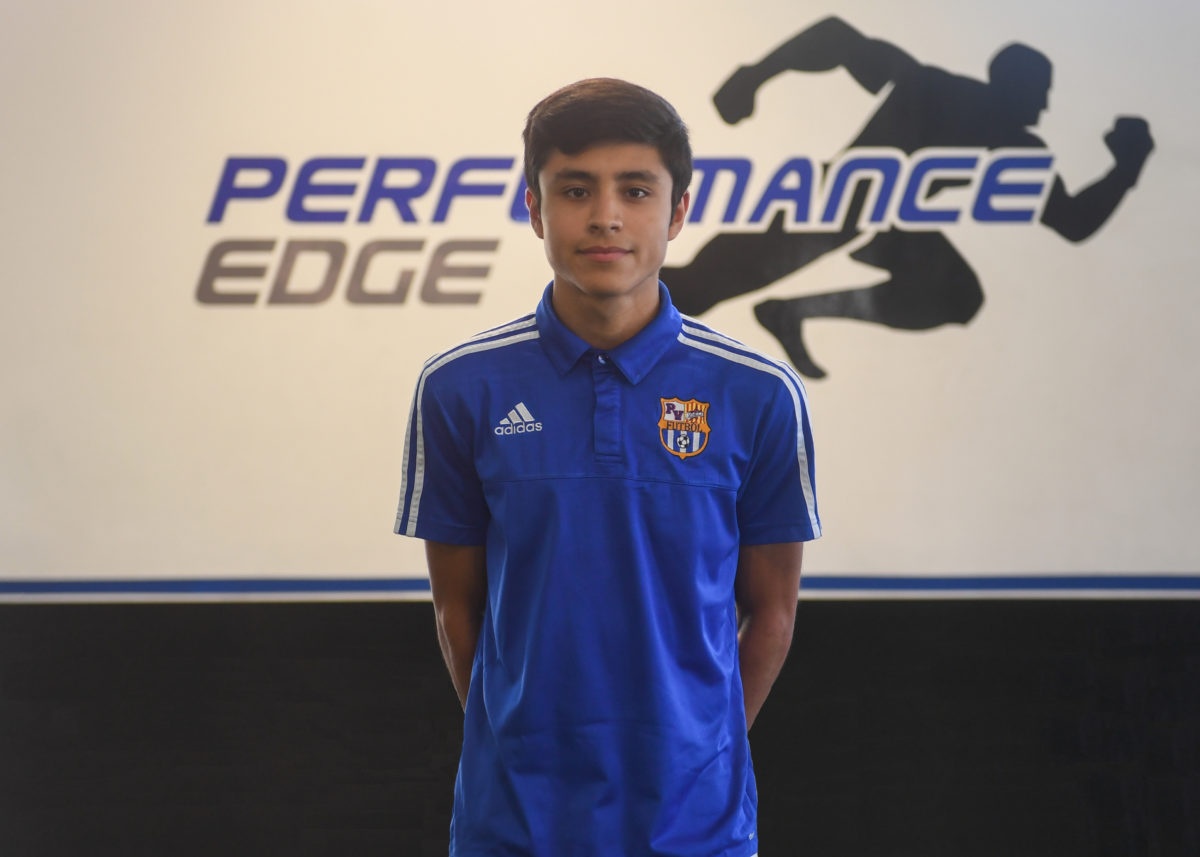
Sterling, VA (May 12, 2017) – Please join us in congratulating Park View’s Obdulio Funez as the April 2017 Performance Edge/Viva Loudoun Athlete of the Month!

The senior forward is finishing his Patriot career in style as he recorded 25 goals and nine assists through the first 13 games of the season. In the month of April, Funez scored a whopping 16 goals in just six games, that’s an average of nearly three goals per game.

“Last year I assisted a lot but this year I’ve taken more of a scoring role for the team,” Funez said. “I’ve improved my finishing, getting around the goal and finishing my opportunities.”

Obdulio Funez recorded at least three goals in four straight games during the month of April. (Photo © Aaron Wyche)

During his hot streak in April, the scoring machine recorded four consecutive hat tricks, which started with three goals against Falls Church on April 5, followed by three-goal performances against Freedom-South Riding and Loudoun Valley, and capped off with a four-goal output against Woodgrove on April 24. Not only did he score three goals against Loudoun Valley, but he also assisted on three more in that contest.

“What’s been getting me going is all the practice my coach has been putting us through, we do a lot of shooting in practice which has helped me score a lot more this season,” Funez said.

Funez’s strong play has helped propel the team to a 12-2 start in 2017 after a perfect 6-0 in April, and all this coming just one season after winning the Virginia 4A State Championship. The Patriots finished the 2016 season 19-3 and knocked off Chancellor in the finals on June 11 to bring the title back to Sterling.

“Winning states was very emotional for us and for the school because the last time we won was 25 years ago, so being able to bring back a championship to Park View and to the community made it emotional and special for us,” he said.

The four-year varsity competitor has had an incredible run with Park View, as he finished with 17 goals and 23 assists as a junior and had three goals to go along with 11 assists as a sophomore.

Funez was named the 2016 Loudoun County Player of the Year. (Photo © Aaron Wyche)

His impressive stats and key contributions to a state championship in 2016 earned him player of the year honors in his conference and region, and was named to the all-state first team. He was also recognized as the Loudoun County Player of the Year.

“My favorite award was Loudoun County Player of the Year because it was special to get noticed as one of the best players in our county,” Funez said.

He gives a lot of credit to Coach Arturo Jimenez for bringing the team together, motivating them properly, and working on the right things during practice.

“Over the years, he [Coach Jimenez] has helped boost my moral and confidence each game since freshman year,” Funez said. “He tells me no matter how many shots I miss I can make the next opportunity. And he has trained me hard enough to get where I am now.”

In terms of playing in college, Funez has interest from George Mason, North Carolina Wesleyan and Keystone College at this point. He is looking forward to playing at the next level and believes his skill-set and vision on the field can be a major asset to his future team.

For now, he has unfinished business in Sterling as he hopes to carry his team to back-to-back state championships, and he just might earn a few more individual honors along the way.

Viva Loudoun: We Live For Loudoun™
Written by Josh Apple
Special to Viva Loudoun
Copyright © Viva Loudoun Media Communications LLC.
All Rights Reserved
@JoshApple1

Getting the Edge: Conditioning and Energy System Development

Conditioning and Energy System Development

Michael Jeffrey MS, CSCS, NASM, FMS, YBT

This day in age being efficient and talented when it comes to a certain skill is essential when you want to see success in sport. There is such a strong emphasis on sport skill that experts in the field are being hired just to work on sport specific skill. Yes, this is very important; but even with all the skill in the world you will not be performing to the best of your ability if you are exhausted at the end of the game. Proper conditioning and development of your body’s energy systems will give you that competitive edge over your opponent who may be just too tired to perform.

How Do I Fix This?

 Our bodies are able to replenish ATP (muscles use for energy) through three basic energy systems: phospagen, glycolytic, and oxidative. These systems utilize our macronutrients (proteins, carbs, and fats) to be metabolized for energy allowing our body to perform work. To improve your conditioning levels and see the best crossover effect on the field, you have to properly train these energy systems.

Why is this important?

 Our body utilizes certain energy systems based on the duration of activity that is being performed. This is important because you want to train the energy system that is mainly used by your sport/activity. The following points show the time durations that are used by our body’s energy systems:

1) Phosphagen System: 1-10 seconds

Our body utilizes the phospagen system to provide ATP for activities that are short durations and high intensity. These activities generally occur between 1 and 10 seconds relying on creatine phosphate in the muscles to replenish ATP. Sports mainly using the phosphagen system: Volleyball, Tennis, Gymnastics, Golf, Field Events, Football

Sample Conditioning Workout:

Set 1: 6 sprint repetitions of 25 yards/30 seconds between reps

2:00 minute rest

Set 2: 6 sprint repetitions of 25 yards/30 seconds between reps

2:00 minute rest

Set 3: 6 sprint repetitions of 25 yards/30 seconds between reps

2) Glycolytic System: 30 seconds-2 minutes

Our body uses the glycolytic energy system for activities occurring between 30 seconds and 2 minutes. During glycolysis the body breaks down carbohydrates stored as glucose to help resynthesize ATP. Sports mainly using the glycolytic system: Basketball, Football, Lacrosse, Soccer (Position Specific), Hockey

Sample Workout 1:

Six 25 yard suicides

Goal time: 40 seconds

Rest time: 40 seconds

Sample Workout 2:

8 tempo 200’s

Goal time: 45 seconds

Rest time: 1:10 minutes

3) Oxidative System: 2 minutes plus

The last and most used system in our body is the oxidative system which re-synthesizes ATP both at rest and low intensity activity. This system mainly uses carbohydrates and fats to produce ATP and generally occurs with low-intensity activities that are longer than 2 minutes in duration. Sports mainly using the aerobic system: Distance Running, Rowing, Soccer (position specific)

Sample Workout:

Fartlek Run: Sprint 20 seconds/Jog 20 seconds/Walk 20 seconds for 20 minutes

There are several sports that use a combination of these energy systems which is why it is important to train all 3. It is vital that you develop all 3 energy systems because at one point or another, whether in life or sport, your body uses one of these energy systems. Yes, focusing on sport-specific conditioning still holds precedence, but you also need to be well rounded when it comes to your energy system development. A tired athlete, no matter skill level, is not a good athlete. So please take the time to not only condition, but condition the right way. Too many people think that you just have to run longer to improve your conditioning level. The fact is that you do not even have to run to improve your fitness levels. Doing high-paced circuits and strength training activities with short rest times can do wonders for improving both your aerobic and anaerobic conditioning levels. So please don’t just run to run! Stick to a plan and condition according to the needs of your sport; I promise you, it will make you a more well-rounded athlete.