
Speed Development and its Implementation into Training
By: Michael Jeffrey, MS. CSCS
The intricacies of being a well-rounded athlete is made up of many different components. Everyone wants to be bigger, stronger, and faster; but the key to being an elite athlete is to peak all of these qualities at the same time. Our goal as strength and conditioning coaches is to make sure our athletes are at their absolute best as they go into the season. As a football player it is great if you are explosive and fast in March, but that isn’t going to necessarily help you as you move into the season. Our body is a complex system that doesn’t like it when you train different parameters at the same. You cannot train strength and power at the same time because the training stimulus to improve both would be too great. The athlete would become over-trained, and he would eventually lose all the positive adaptations he has achieved. This training state can sometimes take months to recover from. You can’t get strong when you are trying to get fast, and you can’t get fast while you are trying to get strong.
Recovery Management
Before I dive more into actual training cycles I wanted to address the topic of recovery and its correlation with improved performance. The increase in performance we want to see will never happen unless the body is properly stressed. Whether the stress is done through resistance training or doing tempo 300 yard runs the body must feel this external load to adapt. In most cases the stress is way too much, and we as strength coaches are always trying to combat this. We implement certain training cycles to help the body recover, but we will constantly be fighting outside factors such as sport coaches, school, time, and many other factors that make it hard to program properly. I can only suggest no matter what time of the sport year it is, that you make a strong effort to focus on recovery. Hydration, sleep, nutrition, soft tissue work, and mobility work must all be part of your annual training plan. Getting fast and strong will all have their time and place when it comes to your annual plan, but your goals won’t be reached unless you implement the recovery tactics. We always have to constantly remind ourselves that our bodies will change and grow outside of the weight room, not in it.
Annual Training Cycle and Speed Development
To really explain how we can peak our speed development I am going to break down each training cycle for an off-season high school football player. This type of plan would be a good example to really peak top end speed and explosiveness as he would move towards his high school season. I am not saying that this is the only way to train your athlete, but it would definitely be a good template to follow if you are looking for somewhere to start.
The following terms will help explain some of the concepts I am about to go over.
1RM: The maximal amount of weight lifted for one repetition.
Volume: The total amount of weight lifted.
Intensity: Percentage of the 1 rep max lifted.
Offseason (Jan-Feb.): Muscular Endurance and Hypertrophy
This is the time of the year to really build the foundation of your athlete. Without a proper foundation the athlete will not be able to handle the total load and volume that will be placed upon him as he moves towards his season.
During this time of year the total volume will be high, while the intensity will be lower. This might consist of sets with 8-12 repetitions at 50 to 60 percent of the athletes 1 rep max. In this phase the athlete will work to improve muscle hypertrophy (muscle growth), neural qualities, and improve their overall work capacity. This will not only prepare the athlete for later phases, but will allow for improvement on quality of technique as well. Lighter conditioning can be worked in during this phase as well to keep the athletes fitness level up, but overall conditioning volume should be low because the emphasis of this phase is to work on muscular endurance and hypertrophy.
Another big emphasis during this phase will be to work on muscular imbalances as well. This is important because movement deficiencies will inhibit that athlete from quality movement on and off the field. This will lead to a higher risk of injury and a less functional athlete.
Offseason (March-May.): Maximal Strength
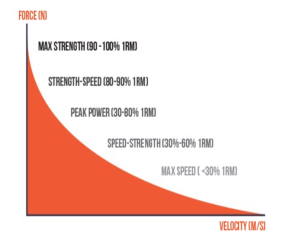
The goal of this phase of training is to get the athlete as strong as possible. No matter what the sport is, strength must be a priority. It will not only help to prevent the athlete from injury, but it will aid in improving the athlete’s overall explosiveness. An athlete cannot be explosive without being strong. During this phase the volume will be low while the intensity is high. The focus of these lifts will be on the compound lifts such as the squat, which can be done by performing sets in the 3 to 5 rep range from 75 to 90 percent of an athlete’s one rep max. Cleans, plyometrics, and other explosive movements can be performed during this phase, but this emphasis should still be on total body strength.
With the intensity of this phase an emphasis should still be made on soft tissue work and recovery. You could do all the heavy lifting in the world, but your body will not adapt unless you are getting the proper recovery out of the gym. This can include anything from sleeping, eating, and nutrition, which will all play a role due to the changes in our body. We will see muscle fiber growth switching from our type 1 aerobic fiber (endurance) to our type 2 anaerobic fibers (strength and power) which will help us to be more explosive in sport.
Lastly, the phase can be accompanied by an increase in the intensity of the conditioning. For one or two days a week it could be good to add some sprints using around a 1:1 work to rest ratio. So, for every sprint you will get the same amount of time as the sprint to recover. You can slowly increase the number of repetitions as well. This will not only prepare the body for the speed and power work later, but it can also aid in active recovery as well.
Offseason (June): Speed Strength
Now that we have completed the meat of our off-season, the next goal is to work on explosive power that is specific for the sport. You could be the strongest guy on the team, but if you don’t move explosively and develop force quickly then you will not be reaching your full potential as an athlete.
In this phase we will be working with medium volume and intensities as the sport specific activities begin to increase. These can be intensities ranging from 50 to 80 percent of the athlete’s one rep max, with the goal of moving the weight as fast as possible. This will improve the efficiency of our central nervous system to help utilize our fast twitch muscle fibers to be explosive in sport thus improving power.
The conditioning volume during this phase will also begin to pick up as well. Now that the athlete has a good aerobic base the athlete will need to start performing conditioning that is more specific to their sport. To start picking up intensity, a good start would be to utilize conditioning methods using a 1:3 work to rest ratio. For example if an athlete was performing sprints that took 10 seconds then they would get 30 seconds to recover. This type of conditioning will be more applicable to the sport, and it can be utilized all the way up to the season.
Pre-season (July-August): Power w/Sport Specificity
Now we will be moving into the pre-season where our weight room volume will significantly decrease, while the on the field volume will dramatically increase. The goal during this phase will be to work on improving power output while keeping the volume low. With all the sport specific work that is going on during this time, we need to focus on quality of work in the weight room, not quantity.
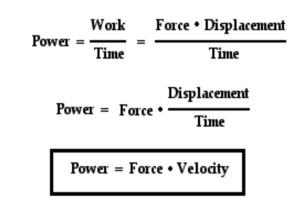
In this phase several of the compound movements will be done working with percentages in the 30-40 percent of the 1RM range. The volume will be fairly low, but our goal is to improve overall anaerobic power. To move with explosiveness and speed weight will be needed to be moved with a higher velocity.
Some higher intensity lifting should be done during this phase to help maintain strength levels as well. Strength should not be the goal of this phase, but it is an important quality to maintain to aid in overall force development.
Outside of the weight room most of the conditioning can be maintained through actual practice, and the conditioning sport coaches will have the athletes perform. During this time is a great place to implement running mechanics and top speed training. This is not meant to be conditioning! If you want to train top speed, then you have to run at top speed. The body must recover fully between reps, and you should never be running in a fatigued state. For top speed training a work to rest ratio of 1:8-10 should be used to make sure the athlete is recovering fully between sets. This is the only way to improve top end speed in regards to actual sprinting. Things such as technique corrections and resisted running can be added, but should not be the focus of training.
In Season (September-December): Maintenance and Recovery
We have finally made it into the actual season where our first and primary goal is performance on the field. If we are not healthy and performing then we as strength coaches have failed to perform our job. An emphasis on recovery and monitoring weight room volume is essential for keep our athletes healthy. Their total volume on and off the field is very high, so we have to make sure that we factor that in. Stretching, mobility work, and soft tissue work should be done as often as possible.
Lifting absolutely should still be performed so we can maintain our strength levels to build off of for the following off-season and to help prevent us from injury. My recommendation is to perform a strength day further away from competition, while a power emphasis day can be performed closer to game day. This is ideal for football, but for some sports with more competition, this style of training may be more difficult. My suggestion is to get it in when you can, even if it is only once a week. Getting stronger is one of the best inhibitors on injury and will only make you more successful on the field.
In Conclusion
So often I hear the questions “What can I do to get faster?” or “What will make me a better athlete?,” which is fair because these are some of my goals as a strength coach. The thing that people need to realize is that to solve these questions we cannot limit our training to help one specific goal. If we only train speed without training strength then we will not be as fast as we could be. If we only train strength without training power then we will not be the most explosive athlete we can be. The total athlete must train all facets to really reach his true genetic potential and be the best athlete he can be on the field.
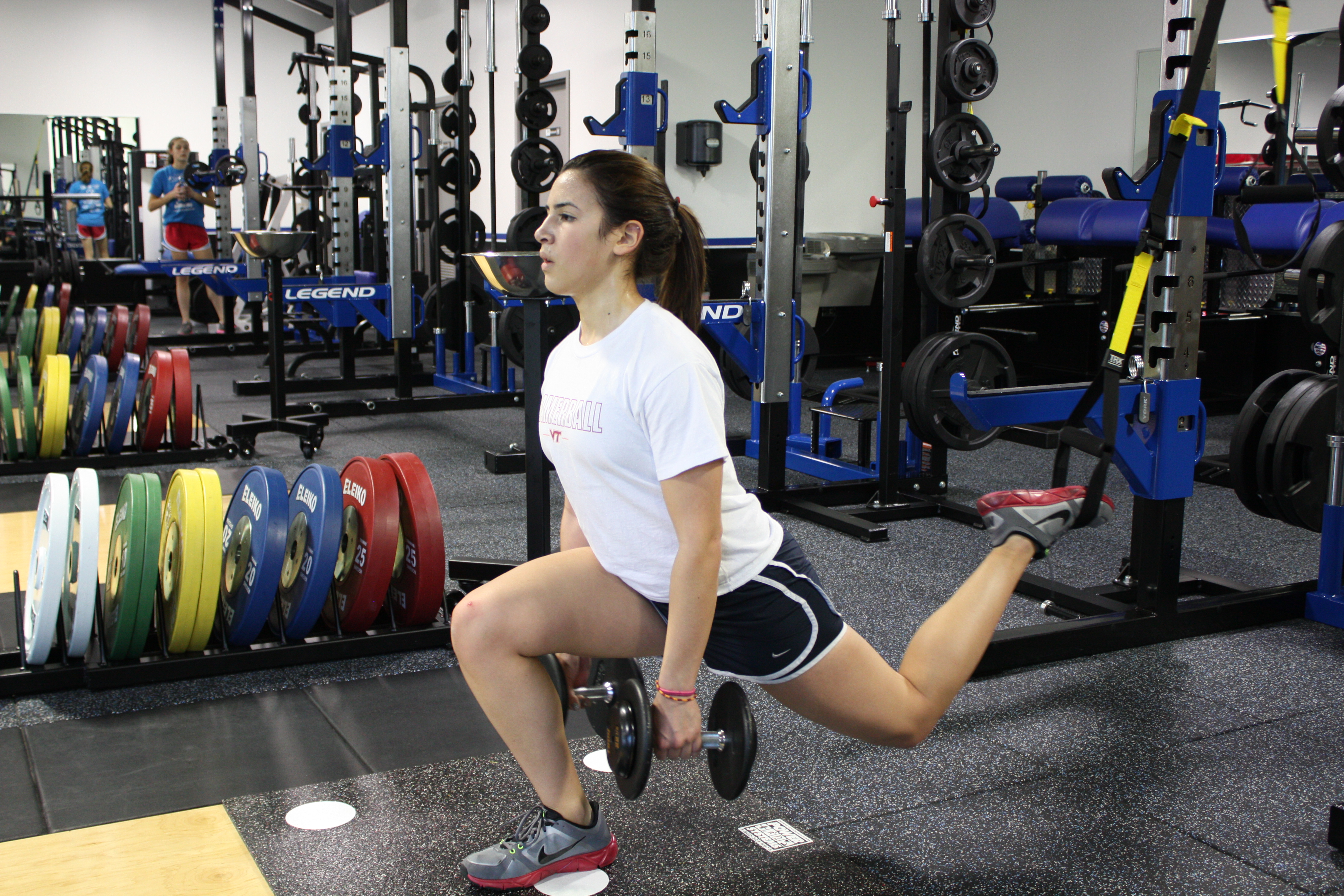
 The volume and intensity of a collegiate strength training program, coupled with the complexity of the playbook, work load and ever increasing competition often leads to unforeseen and unfortunate injuries. As a result, the strength coach must analyze the sport and determine the specific muscular contractions, necessary energy systems, and applicable workloads needed for success and development. The needs of a lineman (tremendous starting power), and that of a volleyball or basketball player (great reactive strength) differ, therefore having them constantly train with the same loads and volume would not be beneficial to their specific needs.
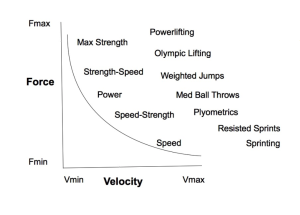 A final and often forgotten element of power development is the component of deceleration. Think of a volleyball player who is rushing up preparing to receive a set, as they approach their take off point momentum is trying to carry them into the net and over the line. If they have the ability to quickly stop and redirect their downward and forward momentum in the opposite direction they will have more success in producing lift (jumping) and hitting the ball toward its intended destination. Training the ability to quickly stop momentum (depth drop; lateral push squat, etc.), in coached biomechanically safe positions, is important in a variety of sports and activities. Learning how to decelerate quickly and reverse direction will increase vertical jump height as well as cutting ability.