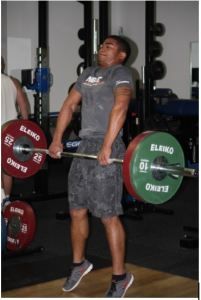
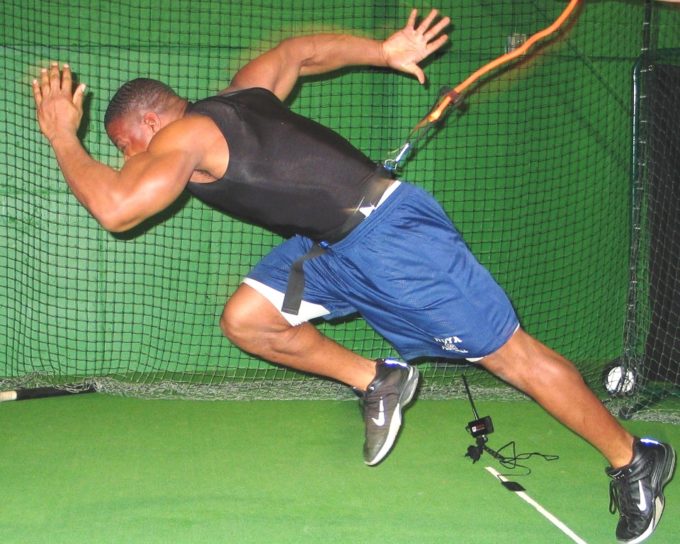
Speed and Agility Training vs Conditioning

By Chuck Burt
Assistant Sports Performance Director

There is a common misconception as to what speed and agility training really is and what exactly that type of training entails. Many individuals; kids, parents, athletes and often times position coaches, think that if they’re heart is beating hard, their out of breath and they’re hot and sweaty they must be getting faster. This thinking is flawed…..quantity doesn’t necessarily mean quality! These individuals may be running around and active, which often times is better than nothing; however it is not teaching them better, more efficient running mechanics. That type of training is more clearly defined as conditioning, or more precisely cardio respiratory conditioning, and in no way should be confused with speed training.

Cardio respiratory conditioning is defined as any form of aerobic exercise that elevates your heart rate and causes your breathing to become somewhat labored for an extended period of time. Cardio training is usually done at a lower intensity level (submaximal speed) and with a higher level of volume (multiple sets). Speed and agility training on the other hand must be done at a higher intensity level (maximal speed) and at a lower work volume, so that the volume of the movements does not interfere with the athlete/individual’s ability to put forth a quality effort due to fatigue. A longer or ample rest period is required for speed and agility training which allows the body to resynthesize glycogen. Glycogen is the fuel that your body uses to drive itself to perform work. If glycogen stores are depleted and not allowed to recover, then the intensity of the work will drop no matter how hard the athlete tries.

Any qualified track coach knows that at the beginning of the season the initial training process should first consist of more conditioning protocols, and progress towards more speed work as the season nears the more important meets and qualifiers. The season starts with higher volume, shorter rest breaks, and as the season progresses the work load and volume drops while the recovery time increases. This allows the ATP-Phosphocreatine and fast twitch glycolytic energy systems (utilized in sprinting) to fully recover.

Speed is a skill, and like any skill, it can be taught – but it must be done with proper progression. The skill must first be taught slowly and in a controlled manner. Before attempting to perform any sort of speed and agility (or explosive) training, you first need to teach the athlete to control their own body. By not doing so runs the risk of the athlete possibly getting injured. The old adage “crawl before you walk; walk before you run” holds true to speed and agility training. First you must learn to control your bodyweight, then learn the skill slowly and finally focus on speed and power. This also holds true about strength development; an athlete cannot be expected to do a squat jump if they cannot squat with good technique. The more control an athlete has over their body, the more efficient they will be in applying force into the ground (Sprinting and Jumping).

A quality program must entail a few things. First, it must incorporate a proper warm up that includes injury prevention. Second, the skill that will be focused on must be broken down into parts that can be understood by the athletes. Next, those parts must then be put back together and coached as a whole. Finally there must be some sort of application that teaches the athlete how this applies to the field or court. This can be a game or a drill, but it must teach them how to use the skill on the field or court.

The skill being taught must be done with a small enough class size that allows the Coach to interact with each individual. Often times many of the Speed & Agility clinics that are offered have 30+ athletes (some of them have hundreds of athletes) and the majority of the time training is focused on conditioning. In that style of clinic, where there’s a large group of athletes, the only ones that get coached are the best athletes. While part of our job is to make good athletes great; I believe the biggest part is to make the below average athlete great. A smaller coach to athlete ratio (10:1) is more beneficial. This will lead to athletes having more success on the field and will help build their confidence; ultimately leading to success off the field (and in all other aspects of their life).

Summers are without a doubt filled with offerings for Speed & Agility clinics. I urge parents and coaches to research Speed & Agility clinics before signing their young athlete up. Ask yourself these questions:

  • What are this person’s qualifications?
  • Do they have a degree which shows they understand the biomechanics and physiology/kinesiology of my son/daughter and do they know how to apply that knowledge?
  • Is there any injury prevention in this program? If so what specifically are they going to do to help prevent my son/daughter from tearing their ACL or helping to prevent my son/daughter from getting a concussion while they play?

IF you get the answers you are looking for from these questions, you found a quality clinic; if not, you should continue your search…….
Strength, Power, Speed: How to Become a Better and More Successful Athlete

by DAVE MIKEL, as published by Viva Loudoun

Year in and year out the one common misconception athletes, their parents and often times many coaches have is that working out and lifting weights will make them slower, stiffer and more muscle bound. In my 15+ years as a professional, collegiate and high school strength & conditioning coach there has always been the consistent correlation that the fastest or quickest athletes were also the most powerful athletes. Those individuals who could jump the farthest and highest were also the fastest running backs, most explosive point guards, best sprinters, most dominating and explosive outside hitters, or pitchers with the most consistent velocity in the game! The NFL, MLB, NBA or NHL players who can accelerate the fastest are most often the ones who can successfully explode with submaximal training loads in exercises such as the squat jump or power squat.  Agility, quickness and speed are definitely synonymous with the rate of performing work, or in other words, power.

Screen Shot 2016-03-15 at 1.58.34 PM Screen Shot 2016-03-15 at 1.58.48 PM             

The most important variable an athlete should work to improve is something known as rate of force development. Simply put, this is the initial acceleration when you start to run or jump. Improving the skill of the movement is the first step in training rate of force development. Any qualified and certified strength coach must first teach an athlete how to properly squat and recruit their posterior chain, glutes and hamstrings which are needed in most athletic movements (running, jumping, landing and stopping). At Performance Edge we constantly see young athletes who are not able to properly use their own body to their competitive advantage because their techniques in athletic movements are lacking and underdeveloped. Once the individual athlete becomes proficient at controlling his/her body weight, then we can move into higher level training. Quite often aspiring athletes try to progress too quickly and attempt to perform technical and complex weight training exercises, such as Olympic lifting, before demonstrating proper postural control.

Once quality biomechanical movements have been obtained through properly demonstrated and cued coaching, a solid foundation of strength development is crucial prior to developing power. Numerous scientific research studies published by the National Strength and Conditioning Association and the American College of Sports Medicine point to a clear correlation between absolute strength and power development in young inexperienced athletes. I often try to equate to parents how not developing strength for a young athlete prior to working on plyometric, speed and agility movements would be as unrealistic as building a fancy penthouse on top of a skyscraper, and then putting very little time and materials into the buildings foundation. It will look good for a while but ultimately you will be looking at some very serious problems down the road. The bottom line is, if you strengthen your lower body, you will become more powerful.

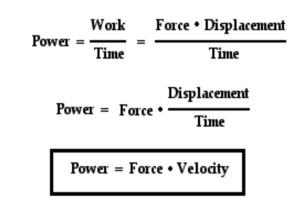
Once strength is increased, each individual athlete must learn how to train with the intent to move or accelerate weight training loads. As indicated above power is a product of force x velocity. If you wish to become more powerful, you must intend to move weight as fast as possible regardless of whether or not the load is heavy or light. Therefore, if you are squatting with a heavy weight, you must try to move the bar up as fast as possible even though the movement speed of the bar might be slow. Your intention to move the weight quickly elicits the neuromuscular response of those muscle fiber types (a.k.a. fast twitch fibers) making them more powerful. Being more focused on every repetition performed is crucial to your power gains. Without the intent to move more explosively you are just working on strength and/or conditioning!

After training with heavier weights and consciously intending to explode concentrically (contracting or shortening the muscle) a more specific methodology of power enhancement may be needed to continually progress more capable or higher level athletes to the next level. Many young aspiring athletes are often not prepared for what is instore for them physically, if they are fortunate enough to attain a collegiate athletic scholarship. Screen Shot 2016-03-15 at 1.59.00 PMThe volume and intensity of a collegiate strength training program, coupled with the complexity of the playbook, work load and ever increasing competition often leads to unforeseen and unfortunate injuries. As a result, the strength coach must analyze the sport and determine the specific muscular contractions, necessary energy systems, and applicable workloads needed for success and development. The needs of a lineman (tremendous starting power), and that of a volleyball or basketball player (great reactive strength) differ, therefore having them constantly train with the same loads and volume would not be beneficial to their specific needs.
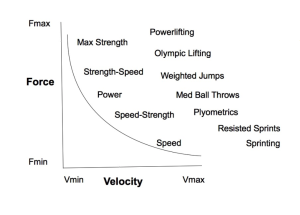
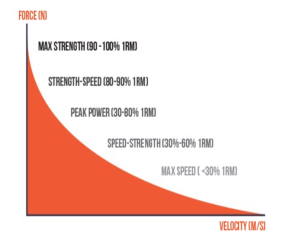
Power development is not the same for all sports. Based on a force velocity curve represented above and below in Figures A and B, the max strength to strength-speed relationship is much more important for a lineman vs. the speed-strength to max speed relationship for that of an outside hitter, point guard or receiver with regard to their individual 1 rep max strength. There is a higher force produced compared to the velocity attained in playing a lineman in football than there would be for a 100 meter sprinter. The velocity of the sprinter would greatly exceed that of the lineman because the force needed to move a lighter weight requires less force and more force is required to move opposing lineman. Both need power, but each need a specific type of power. Whatever the specific requirement, training must then follow to improve those particular qualities of the individual, sport and position. Specificity of training, science based programing, along with certified and experienced coaching is essential to development and results!

Screen Shot 2016-03-15 at 1.59.11 PMA final and often forgotten element of power development is the component of deceleration. Think of a volleyball player who is rushing up preparing to receive a set, as they approach their take off point momentum is trying to carry them into the net and over the line. If they have the ability to quickly stop and redirect their downward and forward momentum in the opposite direction they will have more success in producing lift (jumping) and hitting the ball toward its intended destination. Training the ability to quickly stop momentum (depth drop; lateral push squat, etc.), in coached biomechanically safe positions, is important in a variety of sports and activities. Learning how to decelerate quickly and reverse direction will increase vertical jump height as well as cutting ability. 

Achieving your best takes more than just being active and staying fit. Find a quality sports training program that focuses on your specific needs as an individual, the sport you are playing, or plan to play, and also what position or event you compete. Not all programs are the same and if you want results quality does not come in a can. Always remember, you get what you pay for!

By: David F. Mikel, CEO, Performance Director – Performance Edge

Champions are made in the off-season!


Why Get Olympic Lifting Shoes?

There is a pattern of movement involved when you are performing Olympic weight lifting exercises such as the Snatch or Clean and Jerk. These exercises require that a great amount of force be exerted from your body and is supporter through the feet. Therefore your feet require proper cushioning and padding in order to manage that force. This will allow you to enjoy full benefits of the exercise and avoid injuries.

Why can’t I use regular shoes?

-The main issue when lifting in regular shoes is that they are usually padded on the sole which makes the body ‘sink’ into the shoes when you try to perform our lifts. This will lower your capacity to exert force and press up against the weight because the padding is absorbing lots of tension.

-Another problem is that you have a higher chance of injury due to the instability of in the design of other shoes. An ankle roll when doing heavy weight lifting can be extremely severe. This is because you are normally lifting weights that can cause significant injury if mishandled.

-Weight lighting shoes have a solid flat sole design and less soft cushioned surface, hence, they reduce the chances of ankle rolls and instability issues. Keep the cushioned shoes for activities like running.

Olympic weightlifting shoes: Tools of the Trade

One of the most essential equipment a lifter should own is a pair of Olympic weightlifting shoes. Weight- lifting shoes are secure and keep your foot in place to prevent it from moving. They offer firm contact with the surface and reduce sole compression.
Olympic weightlifting shoes are design from the ground up for the purpose of Olympic weightlifting. When you have a shoe that has a singular focus the end result is a quality product for a deserving sport.

Qualities of Olympic Lifting Shoes

Sole
The soles of the best Olympic weightlifting shoes should be made of rubber which is perfect for both support and traction purposes. It’s important that you feel tightly fixed on the surface with your shoes. If you feel like you are slipping then problems are likely to occur. Most of the best Olympic weightlifting shoes also tend to have a flat sole surface. This is a perfect design for the sport because it promotes greater stability.

Fit
When purchasing Olympic lifting shoes ensure that you buy ones that suit your body and will allow you to lift the maximum quantity of weight you can achieve. Make sure that the shoes are fitting your body well and that you are comfortable in them for long gym sessions. You must know your foot structure.
Do you have narrow feet?

-Do you have narrow wide feet?

-What is you “true” foot size? (Tip: Try on a pair of dress shoes. This is a good way to determine your weightlifting shoe size.)

-Do your feet sweat? (Important in determining if you should get a breathable shoe)

Heel Support

Check the support system the Olympic lifting shoes offer. Look out for firm heel support that makes you feel sturdy. This is particularly essential if you have weak ankles which tend to roll in or outwards when doing squats. You should get less ankle motion and have the ability to hoist more weight.
Also observe the heel high that is right for you. The best Olympic weightlifting shoes will have a heel high between 1/2″ or 3/4″ inches.

Olympic lifting shoes weight

Olympic weightlifting shoe brands offer somewhat different weight so be observant. Expect your typical weightlifting shoe to be heavier than typical running shoes due to the additional support required. In spite of the heavier weight, the shoes should not be too heavy to limit your movements.

Repost: Triple Extension Is Important for All Athletes

By MIKE ROJAS, Aug 24, 2010

iStock_000003777157Small1

Nowadays, speed training is all the rage in almost every sport. You can find “coaches” marketing weekend camps or group training at schools and parks everywhere. Because it’s so heavily marketed to teams and groups, you feel like you’ll be left in the dust if you don’t do it.

I think we can all agree that teaching the mechanics of running is essential for beginners because technique and form are necessary for achieving maximal speed. But with so much emphasis placed on getting faster, what is a parent or athlete to do?

In my opinion, “speed training” is the latest fad to squeeze money out of misinformed coaches, parents, and athletes. Some parents are usually torn between choosing to pay for speed training or strength training. Well, I’m pretty sure you can guess my answer to this dilemma! The biggest bang for your buck is achieved through strength training. The stronger you are, the more force you’ll be able to apply to the ground, which will make you faster.

To get faster, strength training is paramount because:

1. Force = mass x acceleration
2. Power = force x velocity

You’ll also get better triple extension (locking of the ankle, knee, and hip). We all want to develop more force and power, but what does triple extension have to do with all this? Without locking at the hip, knee, and ankle, maximal jumping and sprinting can’t be accomplished. Triple extension is the key to a faster athlete.

Let’s take a look at the NFL combine. The combine is made up of a series of tests—the 40-yard dash, vertical jump, broad jump, bench press, three-cone drill, and shuttle run. Five out of these six events are lower body dominant, and they test the athlete’s ability to explode from a static position to an all out sprint, jump, or lateral shuffle. Guys running a 40-yard dash under 4.25 seconds are very hard to come by. If you can achieve this type of speed at a combine, you can pretty much assure yourself a very lucrative contract. Tenths of a second can mean the difference between thousands or millions of dollars for certain athletes.

Each position player is looked at as a whole, but the hips and legs are highly scrutinized so separating yourself from the pack is very important. With that being said, quickness is brought about by explosive movements such as cleans, snatches, squats, deadlifts, tire flips, and other movements. I’m willing to bet that the guys who stand out on these tests put in a lot of time performing these types of lifts!

Take a look at a basketball player going up for a blocked shot or a slam dunk. He explodes off the ground by applying as much pressure as possible in order to get as high as possible. Triple extension is very important for all jumping movements. With a proper weight training program, athletes can increase their vertical jump and speed and decrease their chances of injury.

1135202_40888264-200x300

Most people wouldn’t think that swimmers need to lift weights let alone incorporate triple extension exercises. But they have to start somewhere and usually it’s on land. If they’re competing in the backstroke, they push away from the wall with an explosive jump. The weights don’t have to be heavy in order to increase the power derived from triple extension. Jumping or deadlifting with light weight can make a big difference in a swimmer’s starting strength.

298051_1512-300x200

Wrestlers definitely need to utilize strength training because they are constantly battling an opponent’s weight and strength. However, do they need to encompass triple extension exercises? Of course. They’re creating tremendous power and force with every throwing movement. For this, we use different types of cleans with dumbbells, kettlebells, and sandbags in order to strengthen their hips. The tremendous grip work involved is an added bonus of performing cleans.

Being a coach, my ultimate goal is to get my clients stronger and faster than their opponents. I teach them technique first, and as they improve, I increase the resistance and workload specific to the demands of their sport. Running around cones and ladders won’t increase their speed nearly as well as a quality strength training program. Time invested in a weight room will yield better results than running with a parachute strapped to your back. It doesn’t matter what surface they compete on—by achieving powerful triple extension through the ankle, knee, and hip, we can create explosive and powerful athletes!

Repost: Two Sides of the Coin- Mobility and Stability

A note from Dave:

As the owner and CEO of Performance Edge I constantly strive to educate my athletes, clientele and those in my community about the necessity and importance of a well-rounded training and/or exercise program. The following article provides some insight as to what the staff and I at Performance Edge work to provide daily…Balance!

Two Sides of the Coin- Mobility and Stability

To start, let’s first give mobility credit where credit is due. Mobility is (almost) everything. If you lack range of motion, no amount of muscle strength will power you through that restricted movement, at least not without serious repercussions – for example, pain. Restricted movements will force the body to compensate, creating further dysfunction. Additionally, if a muscle cannot achieve its optimal length, it cannot generate sufficient force.

In short, good mobility is a basic requirement of quality, safe, and efficient human performance. I am a fan. I’m psyched that the masses are aware that restricted mobility causes trouble and they are ready to take charge and do something about it.

As amazing (and necessary) as mobility is, if it’s “almost” everything, then the other side of the coin is – you guessed it – stability. Stability can exist without mobility, but you wouldn’t get too far. If everything locked down to stabilize, you would have a lot in common with a tree stump. On the other hand, if you had amazing mobility without stability, movement would be next to impossible and sloppy at best.

Thankfully, most of us fall somewhere just off to one side of the correct proportions of each. In other words, we are likely either walking around with a bit too much mobility without sufficient stability, or a bit too much stability without enough mobility.

The Problem of Excess Stability

The first scenario – excessive mobility while lacking stability – is an easy fix. Strength training. Stability work. Get control of all that movement. It would make sense then that in the case of the latter – mobility deficits with excessive stability – the same approach would help. Increase mobility. Stretch, roll, and release. Achieve unrestricted range of motion.

This approach focuses on deficits and increasing what is missing. For my gangly, mobile, Bambi-on-ice patients I want to focus on increasing stability. However, by only trying to increase what is missing, we fail to look at the whole picture. While my goal is not typically to decrease available movement, sometimes, somewhere along the process of increasing stability we might get a reduction in (hyper)mobility. Not necessarily a bad thing.

On the flipside, those with insufficient mobility need to consider the role stability plays in their dysfunction. It is quite easy to come to the conclusion that you have a limited range of motion, but how in the world would you assess that you have an excess of stability? Simple. They are one and the same. Yep, Finkle is Einhorn.

rottenecards37515914wnyjjjj26

That tight muscle you assault on a regular basis is likely an overworked scapegoat, providing stability to keep you going. In the presence of instability, muscles and joints lock up to hold you together. You’ve always known you’ve had tight hamstrings, but you blame it on not stretching enough, too many posterior chain workouts, or perhaps genetics is your excuse. Haven’t you ever wondered the real reason your muscles were tight?

Did you ever consider that maybe those muscles can’t let go because they are holding on for a reason? When muscles start doing more work than they were designed to do, we have a problem. Tendinitis, muscle strains, decreased mobility. If you can teach a muscle to relax, not by pounding it into submission, but rather by turning on the correct muscles to create stability, the tight, limiting offender might just be able to let go.

The Best Application for Mobility Work

So here we are, in the middle of this mobility craze, borderline epidemic. As I approach the end of my first decade working as a physical therapist, I can say with absolute certainty that the number of people suffering from self-proclaimed mobility problems is an all-time high. Just a few years ago, I’m pretty sure I never heard the word mobility used by anyone outside of the health and fitness fields. At this point, it’s a tossup between selfie and mobility for most overused words.

Worse yet, mobility is not just an overused part of our lexicon but it is now becoming the sole approach to address movement dysfunction. Over-prescribing mobility drills for poor movement patterns is not all that different than a physician doling out antibiotics for every ailment. Just like medication, when the right drills are applied for the right condition, mobility work will be successful.

“Normal” mobility, without question, is a requirement to perform safe, efficient, and quality movement. Mobility drills such as stretching, foam rolling, and the like are all good ways to increase soft tissue pliability and increase range of motion. But for those of you consistently chipping away at these drills without yielding the desired change, perhaps it is time to step back and see what else may be going on. It’s time to ask where immobility stems from. If mobility work hasn’t helped yet, I’m not
sure more suffering will get you the results you are looking for.

So, is mobility just a fad? No. It’s a real thing. But it’s not the only thing.

Lauren Beasley, MS, PT, OCS, NKT – Total Physical Therapy