Multiple Oregon Ducks football players hospitalized after grueling workouts

A Note from Dave:

Rhabdomyolysis is no joke! A severe overtraining condition often seen in Crossfit, High Intensity and canned training programs. People aren’t cattle! A quality strength & conditioning program consists of progressive development, individual specificity, adapting volume and intensity levels based on injury prevention and on the clients/athletes specific goals, sport and position. At Performance Edge our qualified, certified and professionally degreed staff provide you the best private individualized training program in Northern Virginia. Bring Your Potential…We’ll Help You Develop it!

View the original article here: http://www.oregonlive.com/ducks/index.ssf/2017/01/oregon_ducks_workouts_hospital.html

UPDATE, Jan. 17: Oregon has suspended its strength coach and issued an apology on behalf of its athletic department after the players’ hospitalization.

At least three Oregon Ducks football players were hospitalized after enduring a series of grueling strength and conditioning workouts at UO last week, The Oregonian/OregonLive has learned.

Offensive linemen Doug Brenner and Sam Poutasi and tight end Cam McCormick are in fair condition and remained at PeaceHealth Sacred Heart Medical Center at Riverbend in Springfield on Monday, a hospital spokeswoman said. They have been in the hospital since late last week after workouts that occurred during the team’s return from holiday break.

Poutasi’s mother, Oloka, said that her son complained of very sore arms after the workouts and had been diagnosed with rhabdomyolysis, a syndrome in which soft muscle tissue is broken down with “leakage into the blood stream of muscle contents,” according to the NCAA medical handbook. Depending on the severity, it has the potential to lead to damaged kidneys.

“The safety and welfare of all of our student-athletes is paramount in all that we do,” Oregon wrote in a statement on behalf of the entire athletic department. “While we cannot comment on the health of our individual students, we have implemented modifications as we transition back into full training to prevent further occurrences.

“We thank our medical staff and trainers for their continued monitoring of the students and we will continue to support our young men as they recover.”

Oregon coach Willie Taggart visited Riverbend to meet with some of the hospitalized players before leaving the state to recruit.

Players this week were required to finish the same workouts, which were described by multiple sources as akin to military basic training, with one said to include up to an hour of continuous push-ups and up-downs. An Oregon official disputed a claim that some players had “passed out,” saying the training staff did not see any players faint; another UO official later said that athletic trainers were available to those who needed treatment during the workouts.

On social media Monday, some players expressed their belief the severity of the workouts had been exaggerated, and that they had been difficult but not out of the ordinary.

Junior cornerback Ugochukwu Amadi wrote on Twitter: “The workout was not even what the media is portraying it to be.”

Some players later complained of discolored urine, which is a common symptom of rhabdomyolysis. After testing, others were found to have highly elevated levels of creatine kinase, an indicator of the syndrome.

Rhabdomyolysis can be triggered after a spike in intensity of an athlete’s workouts and by overexertion during those workouts. For the first time since 2004, Oregon did not qualify for a postseason bowl game in 2016, and players were left to exercise on their own during their nearly monthlong break from school. Oregon hired Irele Oderinde its new football strength and conditioning coach earlier this month. He followed Taggart from South Florida, where Oderinde had worked as the school’s director of athletic performance since 2014.

The 6-foot-2, 310-pound Brenner is entering his senior season, while the 6-4, 315-pound Poutasi and 6-5, 240-pound McCormick will be eligible to play in 2017 after using last fall to redshirt.

Reports of multiple players being affected by rhabdomyolysis are rare. In August, eight volleyball players from Texas Women’s University were hospitalized. In 2011, 13 players from the University of Iowa were hospitalized due to the syndrome after working out during their winter conditioning program. In August 2010, two dozen football players from McMinnville High School were hospitalized, with some requiring surgery, after complaining of intense workouts held in high heat with little water.

The NCAA medical handbook listed “novel workouts or exercises immediately following a transitional period” such as a winter break as one of its 10 factors that can increase the risk of rhabdomyolysis. It also cautioned that “all training programs should start slowly, build gradually, include adequate rest and allow for individual differences.”

— Andrew Greif
agreif@oregonian.com
@andrewgreif

John Champe Basketball Standout Dom Fragala Named Viva Loudoun Athlete of the Month

Aldie, VA (January 18, 2017) – Please join us in congratulating John Champe’s Dom Fragala as the December 2016 Performance Edge/Viva Loudoun Athlete of the Month!

“It feels pretty good because I feel like I put a lot of hard work in this season, and the hard work is paying off,” Fragala said.

Fragala is not only the leading scorer in Loudoun County, but is the top scorer in the entire Washington Metropolitan region. At his current mark of 36.4 points per game, he is nearly six points ahead of the next highest scorer in the region and over 12 points ahead of the next highest scorer in Loudoun County.

At 36.4 points per game, Dom Fragala is the leading scorer in the Washington Metropolitan region. (Photo © Chas Sumser/Viva Loudoun)

His incredible December was highlighted by back-to-back games of 63 and 52 points. His 63-point outburst came on Dec. 12 against Freedom-South Riding, which was the most points scored in a VHSL game since 1984. He followed that epic performance with 52 points on Dec. 19 against Briar Woods, as he was able to knock down seven three-pointers.

“I had two big games that really boosted my confidence, scoring 63 points, I didn’t realize how big that was going to be, but I just work hard and try to achieve more,” Fragala said.

The 63-point performance helped bring Champe back from a large fourth quarter deficit against the Eagles to force overtime and ultimately go on to win. The 52-point game against the Falcons was capped off by knocking down the two game-winning free throws to win by a single point.

“My teammates told me to keep putting pressure on the defense and to keep attacking, and my coaches kept telling me to keep attacking and keep getting to my spots where I know I can make it. I have a lot of trust in my teammates and that’s helps a lot,” he said.

As Champe’s leading returning scorer, Fragala has doubled his scoring average from last year. (Photo © Aaron Wyche/Viva Loudoun)

The 5-foot-11, 150-pound guard is in his second season with the Knights after transferring from Bishop O’Connell, a school that battles in the Washington Catholic Athletic Conference (WCAC), one of the best prep basketball conferences in the nation.

He scored just over 300 points in two seasons with O’Connell, highlighted by a 21-point outing against basketball superpower St. John’s as a freshman.

“At O’Connell I learned a lot about the game, they really grew my knowledge,” Fragala said.

In his first season with Champe as a junior, the versatile scoring threat averaged 18.3 points per game, good for second on the team behind Kuony Deng, who averaged 19.4 points per game.

After losing seven players to graduation, including Deng, Fragala knew he needed to step up as the team’s leading returning scorer this season. Clearly, that mission has been accomplished as he has doubled his output from one year ago. The second leading scorer on this year’s team is Tyler Savage with 10.6 points per contest.

“Our whole last year was basically all seniors, now being one out of three seniors I’ve had to be more vocal and lead by action too.”

Fragala scored his 1,000th high school career point from the free throw line. (Photo © Aaron Wyche/Viva Loudoun)

Fragala eclipsed the 1,000-point threshold for his high school career the day after his 52-point showing in a 38-point performance on Dec. 20 in a win against Manassas Park.

He credits his jump in productivity with the hard work he put in during the offseason. It wasn’t just the time on the court, however, but more the time spent in the gym that has propelled him to success.

“I was in the weight room a lot trying to get stronger and working on my stamina because I knew I would be in the game most of the time,” he said.

Though he still needs to continue getting stronger in order to successfully compete at the collegiate level next year, he has received one Division I offer so far from Mississippi Valley State in Itta Bena, Miss. They compete in the Southwestern Athletic Conference (SWAC). He still hopes to get more offers before the end of the season.

Before he can worry about college basketball, he wants to finish his Champe career on a high note. As far as personal accolades go, he wants to be named all-conference, all-region, and all-state. As for the team, he wants to surpass the success of last year’s squad and make a run at a state championship.

“I just need to keep doing everything I was doing in December and keep the gas pedal down to help the team win games,” Fragala said.

Viva Loudoun: We Live For Loudoun™

Written by Josh Apple
Special to Viva Loudoun
Copyright © Viva Loudoun Media Communications LLC.
All Rights Reserved
@JoshApple1


Viva Loudoun has teamed up with Performance Edge  to recognize an outstanding Loudoun County student-athlete, and their exceptional achievements for a given month by naming a Viva Loudoun Athlete of the Month throughout the  2016-17 academic school year!

We are extremely proud to have Performance Edge on our team.  Dave Mikel, CEO of Performance Edge offers exceptional competitive sports training to exceptional athletes who demand it.

The Performance Edge Mission is to prevent injury, optimize strength and power, and instill confidence and self-discipline.

Loudoun County Volleyball Star Hailey Rubino Named Viva Loudoun Athlete of the Month

Leesburg, VA (December 12, 2016) – Please join us in congratulating Loudoun County’s Hailey Rubino as the November 2016 Performance Edge/Viva Loudoun Athlete of the Month!

“It’s a really big honor to be named Athlete of the Month,” Rubino said.

Changing schools is never easy as a senior, but what a year it has been for Rubino in her first year with the Lady Raiders after transferring from Paul VI in Fairfax, Va. She made the move to be closer to home and to join the ROTC program, but it didn’t hurt that Loudoun County also happens to be a volleyball dynasty in the state of Virginia.

Rubino and the Lady Raiders (29-2) are fresh off their Virginia 4A state championship victory over Jamestown, contested on Nov. 19 at VCU in Richmond. This gave the program their fifth consecutive state title and their ninth in 10 years.

“It’s been a really good experience to be a part of such a big dynasty that we’ve had going for nine years now,” Rubino said.

2016 Region 4A West Player of the Year, Loudoun County’s Hailey Rubino demonstrated her firepower and versatility throughout the match finishing with 15 kills, 8 service points, 2 aces, 1 assist, 2 block assists, and 12 digs. (Photo © Jeff Scudder/Viva Loudoun)
Rubino finished with 15 kills, 8 service points, 2 aces, 1 assist, 2 block assists, and 12 digs in the championship game. (Photo © Jeff Scudder/Viva Loudoun)

Despite getting off to a slow start and dropping the first set to Jamestown, the Lady Raiders came charging back to when the next three sets (17-25, 25-20, 25-22, 25-17) to continue to the dynasty. They finished the season ranked No. 1 in the Washington Post All-Met poll.

“After winning semis, we were all happy we made it that far, knowing we were either first or second,” she said. “Then we went down to VCU and it’s just do or die at that point. The first set wasn’t what we expected, we lost the first set, but we all came back with a fighting spirit and won the next three.”

Rubino, a 5’11” outside hitter and co-captain of the team, had a strong championship performance with 15 kills, eight service points, two aces, one assist, two block assists, and 12 digs.

“I started a little shaky, I think it was because it was states and in a new gym,” Rubino said, “but I was consistent for the most part, I just tried to be a good leader to my team and keep everyone’s spirits up after the first set.”

She believes that her three years of experience at a strong athletic program like Paul VI prepared her for this season and helped her become a better leader. Yet, she admits there was pressure to win when playing for Loudoun County.

“There was a lot of pressure, especially coming into this year, but I think we did well as a team and defeated that pressure,” Rubino said.

Thanks to a brilliant season and a great final game at VCU, Rubino was named the VHSL 4A Volleyball Player of the Year and the Conference 21B Volleyball Player of the Year.

hailey-rubino-1
Rubino was named Conference 21B Player of the Year. (Photo © Michael Hylton/Viva Loudoun)

“I feel really gracious to be named player of the year,” she said, “just coming here as a senior, and having my team behind me definitely helped with that, without them there’s no way I would have been named anything like that.”

At the helm of the dominant program is Coach Sherrilyn Hanna, who was named the VHSL 4A Volleyball Coach of the Year.

“She [Hanna] was great, she really pushed us hard to win another state championship, and she never gave up on us so we never gave up on her,” Rubino said, “she just knew we had it in us and said we might be one of the best teams to come through here at Loudoun County.”

Other key contributors to the Lady Raiders’ success were Hannah Aycock (co-captain), Rachael Cullen, and Anderson Vaughan, who were all named to the VHSL 4A Volleyball First Team, giving the squad four members of the all-state first team with Rubino.

For Rubino, her favorite memory of the epic season was a game early in the playoffs against Millbrook on Nov. 7, in which the Raiders won the first set but then dropped the next two before rallying to win the last two sets, and even had to come from behind in the fifth and final set.

Even after all the success this year, she admits the transition to Loudoun County was difficult in the early stages of the season.

“At first it was hard because I was a new person as a senior,” Rubino said, “but after a couple weeks it was easy and I got to know everyone, and everyone in this program is very talented and the other seniors were all very welcoming and helped me get accommodated to what Loudoun County volleyball was, and that allowed me to do well.”

Rubino signed with the University of New Mexico on Nov. 9. / Photo courtesy LCHS

Prior to setting foot on the Loudoun County campus this fall, she had already committed to play volleyball for the University of New Mexico in July, and signed her letter of intent to join the Lobos officially on Nov. 9.

“I visited last fall and I really loved it there,” Rubino said, “I love the campus and the coaching staff, it just really drew my attention.”

Her final three choices came down to New Mexico, Georgia State, and High Point, but the opportunity to play in the highly competitive Mountain West conference with the Lobos was very attractive for her.

In order to get additional competition outside of the high school season, Rubino is a member of the Metro Volleyball Club of Washington, D.C. She also tries to gain an edge through her workout regiment, as she meets with a personal trainer and has trained with Performance Edge, where they develop individualized strength programs to deal with the physical challenges associated with volleyball.

“I loved working out there, they really helped me get stronger, which helped me improve in volleyball,” she said.

According to Rubino, she uses her high volleyball IQ to her advantage on the court. She has been playing the game since the third grade and is the daughter of two former collegiate volleyball players, Robert and Monica, who she says has been her biggest mentors.

“I think I know the game better than the majority of the other players, so it just gives me an edge to be a leader and help the team,” she said.

Viva Loudoun: We Live For Loudoun™

Written by Josh Apple
Special to Viva Loudoun
Copyright © Viva Loudoun Media Communications LLC.
All Rights Reserved
@JoshApple1


Viva Loudoun has teamed up with Performance Edge  to recognize an outstanding Loudoun County student-athlete, and their exceptional achievements for a given month by naming a Viva Loudoun Athlete of the Month throughout the  2016-17 academic school year!

We are extremely proud to have Performance Edge on our team.  Dave Mikel, CEO of Performance Edge offers exceptional competitive sports training to exceptional athletes who demand it.

The Performance Edge Mission is to prevent injury, optimize strength and power, and instill confidence and self-discipline.

Dominion Football Standout Vashon McCants Named Viva Loudoun Athlete of the Month


Dominion's Vashon McCants eludes one of many defenders prior to launching a 55-yard touchdown pass. (Photo © Aaron Wyche/Viva Loudoun)

Dominion’s Vashon McCants eludes one of many defenders prior to launching a 55-yard touchdown pass. (Photo © Aaron Wyche/Viva Loudoun)

Sterling, VA (November 12, 2016) – Please join us in congratulating Dominion’s Vashon McCants as the October 2016 Performance Edge/Viva Loudoun Athlete of the Month!

“I’m very excited about this honor, it means a lot to me because the progress it took to get here,” McCants said.

The senior has played all over the field for the Titans this season, including significant time at quarterback, running back and defensive back. The versatile athlete has amassed 806 passing yards, 1,162 rushing yards, and has been responsible for 28 touchdowns on the season.

“I’m very patient and I can see the whole field, I see every little lane, every little cutback, my vision is up there,” McCants said. “Since I do have the ability to throw it down the field, that is a huge boost because the corners have to respect that.”

He was responsible for 890 all-purpose yards and 12 touchdowns in the month of October alone in just three games, and was named the Washington Post Player of the Week following a 236-yard and five touchdown rushing performance on Oct. 7 in the Homecoming game against Loudoun County. He also was 7-of-11 passing in that contest for another 64 yards.

“Being recognized by the Washington Post, it gives me joy, I feel happy about it, but I don’t dwell on it, I use it as my motivation to keep doing better,” McCants said.

After opening the season at running back for the Titans, he made the transition to quarterback midway through the fourth game of the season in a loss to Woodgrove on Sept. 16, which dropped the squad’s record to 2-2 early in the season. Admittedly for McCants, the nerves were running high through his system, as it was a new experience.

They determined he was a better fit under center for the remainder of the season to make sure that he had the ball in his hands on every offensive play.

McCants' field vision and elusiveness often resulted in big plays and a frustrated defense. (Photo @ Aaron Wyche/Viva Loudoun)

McCants’ field vision and elusiveness often resulted in big plays and a frustrated defense. (Photo @ Aaron Wyche/Viva Loudoun)

Since making that decision, the Titans have won six straight games to close out the season, making McCants undefeated as the starting quarterback. Prior to this season, the 5-foot-8, 150-pound speedster had not played quarterback since the eighth grade. He did try out for the position, however, prior to the start of this season, but the coaching staff determined he was better suited to play running back at that time.

“I think I am starting to develop to be a quarterback,” McCants said. “I love to play quarterback, it puts me in a leadership role that I say I fit in pretty well.”

Following that strategic maneuver, Dominion finished the regular season with an 8-2 record, clinched the Conference 21B championship, and earned a bye in the opening round of the Virginia 4A West Playoffs.

“People thought I was just a running back playing quarterback,” McCants said, “but our running game helped us so much so that we can pass the ball, and when we do, it’s a thing a beauty, the running game helps set that up.”

The backfield foursome of (from left) Alex Wertz, Billie Walker, Vashon McCants and Jamari Robertson kept the offensive pressure up all night. (Photo © Aaron Wyche/Viva Loudoun)

McCants and the Titans have a bye in the first round of the Virginia 4A West Playoffs. (Photo © Aaron Wyche/Viva Loudoun)

In addition to McCants’ outstanding work on the offensive side of the ball, he is the strongest defensive back for the Titans as he covers the best player on the opposing team each week.

“I love playing defense, I can cover and shut down your top notch guy,” he said.

McCants is only in his second year in Sterling with the Titans after spending his first two prep years with Virginia Academy in Ashburn. He had a solid season one year ago as a running back, but he did not see any time under center.

With his newfound position and the team ending the season with six straight victories, McCants has high hopes for the upcoming playoffs. He believes the defense needs to step up and the offense just needs to keep rolling like it has been over the second half of the year.

“I just think it’s our confidence,” he said, “our vibe we got after our tough loss to Woodgrove, it switched something, it was a changing point for us, and ever since we have just been rolling and our confidence has been through the roof.”


Beyond this season, McCants hopes to continue his career at the collegiate level. Thus far, he has one scholarship offer from St. Francis in Pennsylvania and has received interest from Towson, Richmond, Norfolk State and James Madison. Despite his flexible offensive skill set, he expects to play defensive back at the next level.

Viva Loudoun: We Live For Loudoun™

Josh Apple Headshot-0001cWritten by Josh Apple
Special to Viva Loudoun
Copyright © Viva Loudoun Media Communications LLC.
All Rights Reserved
@JoshApple1


Viva Loudoun has teamed up with Performance Edge  to recognize an outstanding Loudoun County student-athlete, and their exceptional achievements for a given month by naming a Viva Loudoun Athlete of the Month throughout the  2016-17 academic school year!

We are extremely proud to have Performance Edge on our team.  Dave Mikel, CEO of Performance Edge offers exceptional competitive sports training to exceptional athletes who demand it.

The Performance Edge Mission is to prevent injury, optimize strength and power, and instill confidence and self-discipline.

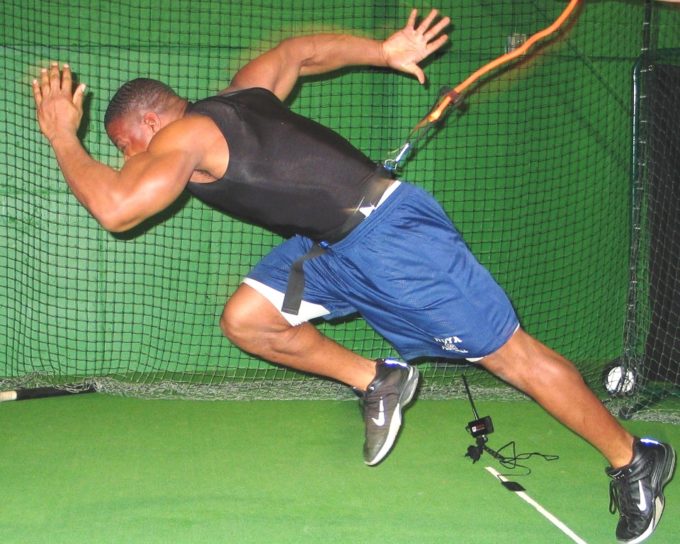
Speed and Agility Training vs Conditioning

By Chuck Burt
Assistant Sports Performance Director

There is a common misconception as to what speed and agility training really is and what exactly that type of training entails. Many individuals; kids, parents, athletes and often times position coaches, think that if they’re heart is beating hard, their out of breath and they’re hot and sweaty they must be getting faster. This thinking is flawed…..quantity doesn’t necessarily mean quality! These individuals may be running around and active, which often times is better than nothing; however it is not teaching them better, more efficient running mechanics. That type of training is more clearly defined as conditioning, or more precisely cardio respiratory conditioning, and in no way should be confused with speed training.

Cardio respiratory conditioning is defined as any form of aerobic exercise that elevates your heart rate and causes your breathing to become somewhat labored for an extended period of time. Cardio training is usually done at a lower intensity level (submaximal speed) and with a higher level of volume (multiple sets). Speed and agility training on the other hand must be done at a higher intensity level (maximal speed) and at a lower work volume, so that the volume of the movements does not interfere with the athlete/individual’s ability to put forth a quality effort due to fatigue. A longer or ample rest period is required for speed and agility training which allows the body to resynthesize glycogen. Glycogen is the fuel that your body uses to drive itself to perform work. If glycogen stores are depleted and not allowed to recover, then the intensity of the work will drop no matter how hard the athlete tries.

Any qualified track coach knows that at the beginning of the season the initial training process should first consist of more conditioning protocols, and progress towards more speed work as the season nears the more important meets and qualifiers. The season starts with higher volume, shorter rest breaks, and as the season progresses the work load and volume drops while the recovery time increases. This allows the ATP-Phosphocreatine and fast twitch glycolytic energy systems (utilized in sprinting) to fully recover.

Speed is a skill, and like any skill, it can be taught – but it must be done with proper progression. The skill must first be taught slowly and in a controlled manner. Before attempting to perform any sort of speed and agility (or explosive) training, you first need to teach the athlete to control their own body. By not doing so runs the risk of the athlete possibly getting injured. The old adage “crawl before you walk; walk before you run” holds true to speed and agility training. First you must learn to control your bodyweight, then learn the skill slowly and finally focus on speed and power. This also holds true about strength development; an athlete cannot be expected to do a squat jump if they cannot squat with good technique. The more control an athlete has over their body, the more efficient they will be in applying force into the ground (Sprinting and Jumping).

A quality program must entail a few things. First, it must incorporate a proper warm up that includes injury prevention. Second, the skill that will be focused on must be broken down into parts that can be understood by the athletes. Next, those parts must then be put back together and coached as a whole. Finally there must be some sort of application that teaches the athlete how this applies to the field or court. This can be a game or a drill, but it must teach them how to use the skill on the field or court.

The skill being taught must be done with a small enough class size that allows the Coach to interact with each individual. Often times many of the Speed & Agility clinics that are offered have 30+ athletes (some of them have hundreds of athletes) and the majority of the time training is focused on conditioning. In that style of clinic, where there’s a large group of athletes, the only ones that get coached are the best athletes. While part of our job is to make good athletes great; I believe the biggest part is to make the below average athlete great. A smaller coach to athlete ratio (10:1) is more beneficial. This will lead to athletes having more success on the field and will help build their confidence; ultimately leading to success off the field (and in all other aspects of their life).

Summers are without a doubt filled with offerings for Speed & Agility clinics. I urge parents and coaches to research Speed & Agility clinics before signing their young athlete up. Ask yourself these questions:

  • What are this person’s qualifications?
  • Do they have a degree which shows they understand the biomechanics and physiology/kinesiology of my son/daughter and do they know how to apply that knowledge?
  • Is there any injury prevention in this program? If so what specifically are they going to do to help prevent my son/daughter from tearing their ACL or helping to prevent my son/daughter from getting a concussion while they play?

IF you get the answers you are looking for from these questions, you found a quality clinic; if not, you should continue your search…….