Call and register today for June 21st!
Competitive Sports Training

by DAVE MIKEL
Each and every year I hear the same thing from those that have worked hard throughout the off-season; lifting weights, conditioning, speed and agility work, stretching, etc… as soon as their sports season begins they stop working out and say, “I’ll see you after the season’s over”. Why? Look at it this way, you’ve worked hard all season long in preparation for your sport with expectations of having a great season, and then you stop doing what made it all possible.

The question that every athlete should be asking and seeking expert advice on is, “What should I be doing during the season to maintain all the great gains I made off-season?” The answer has to do with specificity and reduced training volume.
As a full-time strength and conditioning coach in the NFL, college and high school I made sure that our pre-season phase (4-5 weeks) was the most sport and position specific as possible. In addition, I reduced the amount of lower body weight training as a means of tapering. The program was designed this way to enhance performance, and to prevent injury during training camps. In-season training maintains this same philosophy.
These same training principals apply, whether you are a professional athlete, a young amateur athlete, or consistently competing in recreational events. My 15+ years of strength coaching experience at all levels has taught me that in order to efficiently maintain the strength and power you developed in the off-season, the majority of your weight training workouts should be explosive in nature and trained with reduced volume. To better understand this, let’s first look at what explosive weight training means.
Power Training
Power and explosiveness is of high priority in most sports. There are a number of training methodologies that teach power production, but remember whatever exercise you are performing to enhance lower body power, you must consciously intend to explode, be it with light or heavy weight. The intent to move quickly elicits the fast twitch muscle fibers, and the intensity of that intent creates the contraction strength. In other words, if you want to move quickly, and with power, you must try as hard as you are able.
Since the majority of your lifts/training during the in-season should be explosive in nature, you must limit or omit (especially with respect to your lower body) training that is “bodybuilding” in nature. This is where the reduction of training volume is critical.
Reduced Volume
Volume refers to the total number of sets and reps performed for each exercise. Bodybuilding (muscle-building) protocols dictate that a moderate number of repetitions/set be performed (8-12). Multiple sets within this repetition range are also performed at a very high intensity of effort. The problems associated with using bodybuilding methods during the season are: 1) it is very fatiguing, and 2) not specific to the types of muscular contractions required in your sport. Instead, perform a lower volume of reps/set (2-6), and total sets (2-4) for each lower body exercise; two exercises at most per session. Perform these exercises with a moderate amount of weight and intend to explode on every rep of every set to enhance power, even if the weight feels heavy. Explosively performing a lower volume of training will not only keep you strong but maintain the lean body mass that you have achieved during the off-season.
When I tested the NFL, collegiate, and high school players during the season, I found that we were very effective in maintaining strength and lean body mass when our players trained in the manner described above. While working with Mark Nemish, the strength and conditioning coach for the Washington Capitals, electronic devises we used that measured power, also showed that we maintained lower body explosiveness very effectively throughout the season. Training with a reduced volume, but with explosive contractions, will also serve to conserve your energy for more important aspects of your in-season: skill training, injury pre-habilitation, and performance.
Skill Training:
Having had the opportunity to have played and work at various levels of prep, collegiate and professional sports, I have had the privilege to learn from several wise and extremely knowledgeable coaches. As a strength coach, I have several functions I am tasked with, but the one thing Sam Rutigliano (former Head Coach of the Cleveland Browns and Offensive Coordinator for the Barcelona Dragons and Scottish Claymore of the NFL Europe League) impressed upon me was the notion that during the season, the players must be ready to play the game. Thus, by following the training guidelines outlined above, you will give yourself a much better chance to be recovered for your games and practices than if you employ muscle building methods. It is during games and practices that your skills must be showcased and honed. Remember, you can’t play the game in the weight room!
Finally, it is a great time during the season to work on injury prevention strategies specific to your sport and your own history of injuries. Many of our players receive specialized exercises addressing their specific weaknesses during the year. Rotator cuff strengthening for weak shoulders or specialized abdominal workouts for those with low back problems are examples of these specialized injury pre-habilitation protocols.
In summary, in-season training for your sport is crucial in terms of maintenance and injury prevention. Remember, reduce the volume of your strength training work and perform the majority of your lower body exercises in an explosive fashion. This will aid in maintaining strength, lean body mass, and explosiveness while sparing your energy for more important methods of preparation and competition.
Have a great season, and remember quality over quantity! Stay Strong!
Many women believe that lifting weights will result in them looking like men, bulking up, or stop burning calories. All of this is untrue! The women you see who look like men, with the grossly large muscles, in general are taking testosterone supplements and possibly steroids in order to look that way. They also spend an inordinate amount of time (3 to 5 hours a day, 5-7 days a week) in order to obtain that large size and muscle development. Don’t take those things and make lifting your everyday job and you won’t look that way! In fact you will look slim, sleek and fit. Instead of being skinny fat – you know where you look ok in clothes because you’re thin, but not so good in a swimsuit because you have no lean muscle – you will be healthy and look amazing in practically everything.
Okay so you want reasons to lift heavy weights instead of tiny dinky ones?
1. It builds muscle faster.
I’m sure you’re sitting there thinking “Well duh, weight lifting = building muscles, who knew?!” But I just wanted to reiterate that while lifting light weights can increase your endurance, it’s nothing more than weighted cardio. To build real muscle you need to lift heavy weights. You want to lift the heaviest weight you can lift for 8-12 reps, if you can’t lift 8 reps it’s too heavy if you lift more than 12 reps it’s too light.
2. According to The Journal of Strength and Conditioning Research, when you build muscle you burn fat continuously! 2 sessions of heavy lifting a week will burn 3% body fat in 10 weeks without cutting calories. You’ll also burn 100 more calories than if you did only cardio, even though your heart rate monitor and calorie counter may tell you that the cardio you just did for an hour burned more than weight lifting, throughout at 24 hour period weight lifting will continue to burn calories and end up burning 100 more than the “cardio only” counterparts. (Put cardio and weight lifting together for a fantastic continuous burn!)
3. In a study from the University of Alabama in Birmingham they showed that dieters who lifted heavy weights lost the same amount of weight as dieters who did just cardio, but all the weight lost by the weight lifters was primarily fat while the cardio ladies lost muscle along with some fat. That equaled smaller clothing sizes for the weight lifters compared to the cardio goers.
4. Lifting weights prevents osteoporosis and can even help build stronger bones.
5. Women who lift heavy weights lose more belly fat than those who don’t. Weight lifting targets intra-abdominal fat and helps you lose the pooch and enjoy a flat belly faster than cardio and more lean muscle than cardio.
6. Lifting heavy weights makes you feel amazing. Lifting heavy weights successfully can aid in building your self-efficacy, and leave you feeling like you can take on the world! A feeling of
empowerment, knowing that you aren’t some weakling walking alongside the road and that people may misjudge you and you could prove them wrong.
7. Strengthening your muscles can help with your cardio. If you are still a cardio lover, adding some weight lifting can improve your knees and joints so that your runs are faster and less painful. Muscles absorb the stress or impact that would normally be relegated to your bones, tendons, and joints! Stronger muscles mean injury reduction and less wear and tear on your joints!
8. You’ll reduce your risk of heart diseases and diabetes, “Muscle helps remove glucose and triglycerides from the bloodstream, which reduces the risk of type II diabetes, as well as hardening of the arteries,” says Timothy Church, MD, PhD, a preventive medicine expert at Pennington Biomedical Research Center.
Cardio is still a great workout, but high impact workouts which can be hard on the knees and joints, and anyone who does both cardio and weight lifting will gain the most benefits.
Adults….if you’re not already doing so, you need to incorporate strength training into your fitness routine. Although all of us will have some degree of muscle loss over time, how much muscle is lost and how fast it happens depends a lot on how well we take care of our bodies. Staying active and exercising regularly can significantly slow muscle loss due to aging.
The process of losing muscle mass as we grow older is called aging sarcopenia. Sarcopenia is, in its most literal sense, the loss of muscle mass, strength and function related to aging. It begins around the age of 25, but it becomes much more noticeable after age 50. As we lose muscle mass, our bodies get weaker.
To decrease the effects of sarcopenia, you need to build muscle. To build muscle you need to engage in some form of resistance training that will place a load on the muscles hard enough to stress them into getting stronger.
Combining strength training with aerobic exercise, as well as, mobility/stability and stretching exercises can increase the benefit to your muscles even more. An added advantage is that this type of regular physical activity can promote heart, bone, metabolic and mental health, too.
Loss of muscle mass is a process that comes with aging, but you have the power to control it. Regularly making time to fit exercise into your schedule is well worth it. You will see long-term benefits not only in strength, but also in your flexibility and balance, and improvement in your overall fitness, health and — particularly important — your quality of life.
Ready to get stronger?….Don’t know where to start?……Stop in and talk with us, we’d love to help.
How Are You Teaching the Squat?

You have a young athlete who walks into your weight room for the very first time. He has never participated in exercise other than his youth football games a few times a week, let alone any sort of weight training. You decide you want your athletes to squat today, so you grab a 25-pound kid bar, have the athlete put it on his/her back and instruct to squat down and come back up.
You notice it looks terrible. The athlete’s body flies all other the place, knees are caving in, and heels are no where close to the ground. What do you do now?
The real question is, what should you have done first?
At Performance Edge in Lansdowne, Virginia, Dave Mikel and his staff take each athlete (and adult) through an initial evaluation. Not every person moves the same, so why do the same thing?
As a strength coach, this assessment is key in observing how well athletes move, their training age, and knowledge base of training. Determining each individual’s strengths, weaknesses and deficiencies drives how we begin and progress each individuals programming. Simply sitting down and standing up may seem simple, but for an athlete who doesn’t have these patterns ingrained in them, you will need to figure out how to cue, coach, and progress and regress the squat.
Owner J.L. Holdsworth from The Spot Athletics, in Columbus, Ohio utilizes a very simple yet effective process in teaching the squat that we at Performance Edge believe in as well.
“The programing should adhere to the needs of the individual, not the individual meeting the needs of the program!”
J.L. Holdsworth
Wall Squats
The first progressions that JL will have an athlete do are wall squats. These squats use an internal cueing method that makes an athlete conscious of keeping their chest up and sitting their butt back first to avoid “eating” the wall.
“Not all athletes need to start here, it is just a good drill to put them into if they are having trouble grasping the pattern.”
J.L. Holdsworth
Cues: What you will see with a lot of young athletes is that they break at their knees before the hips. Continue to tell them “hips back first” and “hips back”. Another big issue is that athletes often keep their chests down. Yes, you can say “chest up, look up”, but some kids still won’t understand it.
“Let me see your logo” is a great cue for athletes. This will keep their chest up by thinking about having to show you the “TROPHIES STACKIN” logo on their shirt (or whatever logo is on their shirt that day). “Knees out” and “spread the floor” are also some good internal and external cues to get kids to keep their knees out, especially when coming up from a squat.
Box Squat
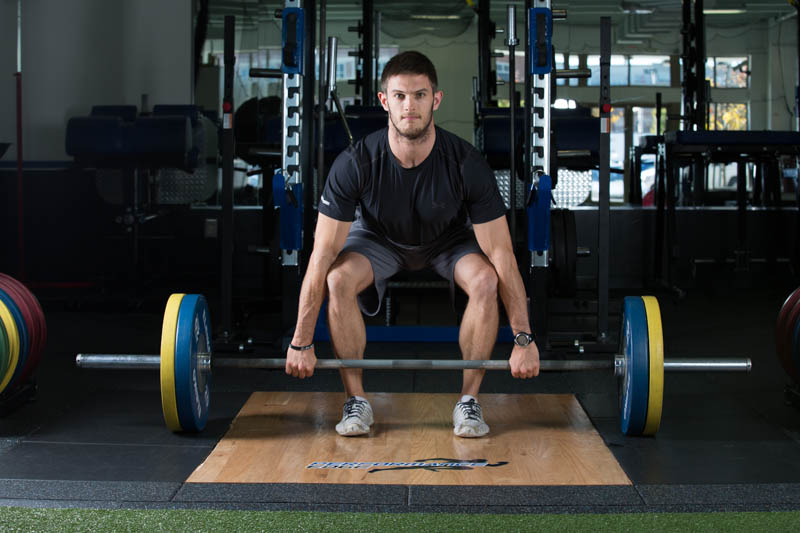
Box squatting is an excelling squatting drill to get your athletes to think about “hips back.” JL starts his athletes here before they move on to a free squat to really engage that posterior chain when squatting. Coaching points for the box squat include a wider stance, toes pointing out, hips back first, knees should not come over their toes, nice controlled descent to the box, don’t “plop” on the box, and stand straight up without the knees shifting forward.
If an athlete is still unable to grasp the concept of controlling themselves to the box, build the box height higher. This means that their hamstrings and glutes are so weak that they won’t let them descend without falling down. If they can do a great box squat, load it goblet style with a dumbbell or kettlebell.
Getting to depth: Weak glutes or poor hip and ankle mobility will stop any athletes from hitting depth in the squat. So how do we fix this? One method is putting plates under their heels. This automatically puts them into a hinge, so it is a smoother transition into the squatting pattern. This also helps with ankle mobility as well.
Another good drill is to have an athlete put plates under their heels and stand in front of a box while holding a light plate out in front of them. Then they must squat down until the plate hits the box and hold. Make sure the box is an appropriate height, and keep the athlete down in that position to feel what it is like for their glutes to be working hard at the bottom of a squat.
Depending on your standards, proper depth is the most difficult aspect of squat technique to ascertain. As a coach, this simple fact is why the goblet, front, or even box squat is such a valuable progression and regression. Depth will be the most prevalent discrepancy when transitioning to the [back] squat.
– Mark Watts
Free Squatting
Box squatting is a great drill and very good for athletes, however, it still won’t make you better at the squat. Take away the box and move into a kettlebell goblet squat. JL recommends starting older athletes and adults with at least a 35-pound kettlebell to progress up to that 45-pound barbell. Young athletes will start with a 20-pound kettlbell, because his athletes will start with a 25-pound barbell.
Front Squat
Front squats are great because they force an athlete to use all of the cues that have been engrained in them by coaches. If they don’t keep their chest up, the bar will drop forward. If they don’t keep their knees out and break at their knees first, the chest will usually fall forward, hence the bar falls forward again. Just make sure you teach the athletes to get into a position of comfort, either rack position or the cross-over position. Elbows have to be up.
Teaching is Learning Twice
Teach your athletes to coach each other. The more you teach them, and have them to teach other fellow athletes, the better they will be. Tell them what to look for in a squat. When an athlete is squatting, ask an athlete watching, “what could you say to make this squat better, what do YOU see wrong?”