Tuscarora Golfer Michael Brennan Named Viva Loudoun Athlete of the Month

michael-brennan-tuscarora-golf-september-athlete-of-the-month-1

Tuscarora golf’s Michael Brennan, the 2016 Viva Loudoun September Athlete of the Month. (Photo © Aaron Wyche/Viva Loudoun)

Tuscarora's Michael Brennan earned 1st place low medalist honors for the 2016 Conference 14 Golf Championship (Photo © Aaron Wyche/Viva Loudoun)

Mikey Brennan won low medalist honors in 9 of 11 matches for Tuscarora as a freshman. / photo © Aaron Wyche/Viva Loudoun

Loudoun County, VA (October 9, 2016) – Please join us in congratulating Tuscarora’s Michael Brennan as the 2016 Viva Loudoun September Athlete of the Month!

Most freshmen are simply trying to find their way as they adjust to the new reality that is high school. Especially when it comes to a fall sport like golf, which opens its season before school even begins, success among rookies is a rare beast.

Michael Brennan is not like most freshmen.

The 14-year-old is not only leading the way for the Tuscarora Huskies, but he has proven to be one of the best players in the entire region.

He has failed to earn medalist honors just twice all season, as he has posted the low score in nine out of 11 matches. Most notably, he was low medalist at the Conference 14 Championship at 1757 Golf Club on Sept. 21 as he fired a 71 (+1), as well as a the Region 5A North Championship at Brambleton Golf Club on Sept. 28, again shooting a 71 (-1).

“I practice as much as possible, I’m always focused and determined,” Brennan said, “I have a goal on what I want to accomplish that day, whether it’s work on a swing change or my putting, and with that I’ve been able to play number one and win a lot of matches.”

Known as Mikey by his peers, his 71 in the region championship came in difficult conditions on a rainy day, proving this freshman is well beyond his years. The young gun birdied holes 9, 10, 11 and 16 en route to his 1-under round.

“On 16 it really started raining hard, I brought out the rain gloves, the rain jacket, just trying to hit the fairway and hit the green and make pars, but I actually birdied that hole,” Brennan said.

tuscarora-team-region-5a-north-champions-photo-aaron-wyche-viva-loudoun-1

Tuscarora won the 5A North Championship as a team held at Brambleton Golf Club on Sept. 28. / photo © Aaron Wyche/Viva Loudoun

Riding Brennan’s wave of success, the Huskies as a team were able advance from the Conference 14 tournament in a playoff, as they finished tied for second with Stone Bridge just one shot behind Briar Woods. After outlasting the Bulldogs for the second qualifying spot, they went on to win the Region 5A North tournament with a team score of 310, finishing just one stroke ahead of Halifax and three ahead of Atlee.

“I really like our team, it’s a lot of fun, practices are fun every day after school,” Brennan said. “Our team is really starting to come around and starting to believe and be confident.”

Next for Brennan and his pack of Huskies is the state championship, which will be contested at Magnolia Green Golf Club, located just outside Richmond, on Oct. 10 and 11.

“I just want to go out there and have fun, it’s my first time,” he said, “it’s going to be a really cool experience, the whole team will be there, and I hope the rest of the kids on the team will play well too.”

Brennan doesn’t expect to just show up, however, as his hopes are extraordinarily high.

“I want to win states, that’s been my goal for this whole high school year, that’s what I’ve been going towards in practice,” Brennan said.

At the helm for the Tuscarora golf team is Coach Jeff Kaplan, who works at the Golf Club at Lansdowne where the team holds practice daily.

“As a young freshman coming in, he’s not intimidated at all by the other golfers in the region,” Kaplan said, “he’s very confident and competitive, and he’s doing a great job with some of my back-end golfers to help them get their games better, and mentoring them, he’s a very well-rounded kid.”

Brennan’s meteoric rise is due in large part to his father, also Michael, who serves as the assistant coach for the Huskies.

“He’s played a lot of competitive amateur golf, he knows what he’s talking about,” said Brennan about his father, “and he’s helped our team a lot with the basics like tempo and balance, and helped a lot with chipping and putting.”

Brennan is hoping to win states held at Magnolia Green on Oct. 10 and 11./ photo © Aaron Wyche/Viva Loudoun

Brennan is hoping to win states held at Magnolia Green on Oct. 10 and 11./ photo © Aaron Wyche/Viva Loudoun

Another key contributor toward Brennan’s success is his swing coach Adam Harrell, founder of the Elite Performance Golf Academy at Westpark Golf Club in Leesburg.

“When he first came to me at 11, he was not really that into golf, he was just starting to think about it,” Harrell said, “but he set some goals and he went after them and tried to achieve them and he made some great progress. Once he committed to playing golf more full time and became very focused, he kind of exploded.”

Until he was 11, the father-son duo worked together exclusively, developing Mikey into a sound young golfer with lots of potential. They continue to work together, but Harrell has been able to help polish those raw skills into a more efficient machine, all culminating in a dominant freshman year performance.

“What he’s doing is really impressive, but he is still just scratching the surface because of how young he is, he doesn’t have a ton of experience yet in high-level competitions,” Harrell said. “But I’m not surprised, he has a very high golf IQ, he is driven, motivated, talented and he is easy to work with.”

Brennan took advantage of a recent putting lesson, which he credits as the biggest reason why he was able to win the region. Not only did he see a big improvement in his putting, but he also used a set of Harrell’s clubs to win both the conference and the region, as they determined he had outgrown his own set.

Despite being relatively late to high-level competition, Brennan had a busy summer earlier this year prior to the start of his first high school campaign. He competed in the Virginia State Amateur, came in 14th at the U.S. Kids Team World Championship at Pinehurst No. 9, played in several Hurricane Junior Golf Tour events, and won the Junior Valentine at Hermitage Country Club in Richmond.

Even if Brennan does go on to capture the state championship as a freshman, he still believes he has plenty more to do over his next three years at Tuscarora.

“If I win states, next year my goal would be the same,” he said, “I would go out and work as hard as I can and try to beat my score from this year.”

Viva Loudoun: We Live For Loudoun™

Josh Apple Headshot-0001cWritten by Josh Apple
Special to Viva Loudoun
Copyright © Viva Loudoun Media Communications LLC.
All Rights Reserved
@JoshApple1


Repost from Viva Loudoun
Speed and Agility Training vs Conditioning

By Chuck Burt
Assistant Sports Performance Director

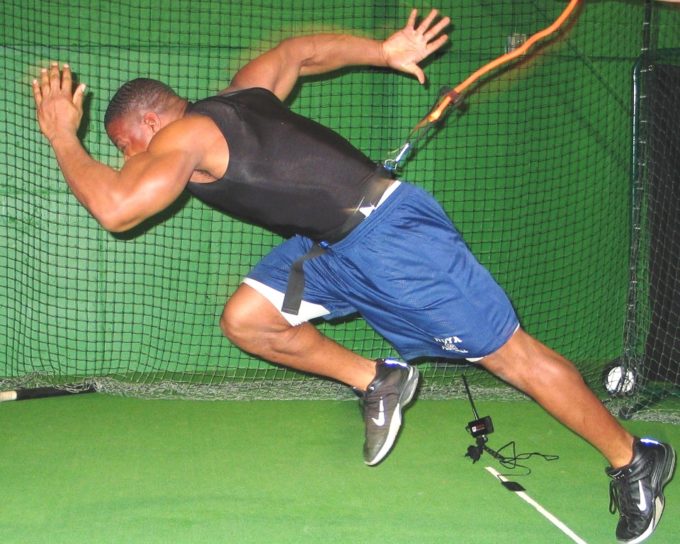
There is a common misconception as to what speed and agility training really is and what exactly that type of training entails. Many individuals; kids, parents, athletes and often times position coaches, think that if they’re heart is beating hard, their out of breath and they’re hot and sweaty they must be getting faster. This thinking is flawed…..quantity doesn’t necessarily mean quality! These individuals may be running around and active, which often times is better than nothing; however it is not teaching them better, more efficient running mechanics. That type of training is more clearly defined as conditioning, or more precisely cardio respiratory conditioning, and in no way should be confused with speed training.

Cardio respiratory conditioning is defined as any form of aerobic exercise that elevates your heart rate and causes your breathing to become somewhat labored for an extended period of time. Cardio training is usually done at a lower intensity level (submaximal speed) and with a higher level of volume (multiple sets). Speed and agility training on the other hand must be done at a higher intensity level (maximal speed) and at a lower work volume, so that the volume of the movements does not interfere with the athlete/individual’s ability to put forth a quality effort due to fatigue. A longer or ample rest period is required for speed and agility training which allows the body to resynthesize glycogen. Glycogen is the fuel that your body uses to drive itself to perform work. If glycogen stores are depleted and not allowed to recover, then the intensity of the work will drop no matter how hard the athlete tries.

Any qualified track coach knows that at the beginning of the season the initial training process should first consist of more conditioning protocols, and progress towards more speed work as the season nears the more important meets and qualifiers. The season starts with higher volume, shorter rest breaks, and as the season progresses the work load and volume drops while the recovery time increases. This allows the ATP-Phosphocreatine and fast twitch glycolytic energy systems (utilized in sprinting) to fully recover.

Speed is a skill, and like any skill, it can be taught – but it must be done with proper progression. The skill must first be taught slowly and in a controlled manner. Before attempting to perform any sort of speed and agility (or explosive) training, you first need to teach the athlete to control their own body. By not doing so runs the risk of the athlete possibly getting injured. The old adage “crawl before you walk; walk before you run” holds true to speed and agility training. First you must learn to control your bodyweight, then learn the skill slowly and finally focus on speed and power. This also holds true about strength development; an athlete cannot be expected to do a squat jump if they cannot squat with good technique. The more control an athlete has over their body, the more efficient they will be in applying force into the ground (Sprinting and Jumping).

A quality program must entail a few things. First, it must incorporate a proper warm up that includes injury prevention. Second, the skill that will be focused on must be broken down into parts that can be understood by the athletes. Next, those parts must then be put back together and coached as a whole. Finally there must be some sort of application that teaches the athlete how this applies to the field or court. This can be a game or a drill, but it must teach them how to use the skill on the field or court.

The skill being taught must be done with a small enough class size that allows the Coach to interact with each individual. Often times many of the Speed & Agility clinics that are offered have 30+ athletes (some of them have hundreds of athletes) and the majority of the time training is focused on conditioning. In that style of clinic, where there’s a large group of athletes, the only ones that get coached are the best athletes. While part of our job is to make good athletes great; I believe the biggest part is to make the below average athlete great. A smaller coach to athlete ratio (10:1) is more beneficial. This will lead to athletes having more success on the field and will help build their confidence; ultimately leading to success off the field (and in all other aspects of their life).

Summers are without a doubt filled with offerings for Speed & Agility clinics. I urge parents and coaches to research Speed & Agility clinics before signing their young athlete up. Ask yourself these questions:

  • What are this person’s qualifications?
  • Do they have a degree which shows they understand the biomechanics and physiology/kinesiology of my son/daughter and do they know how to apply that knowledge?
  • Is there any injury prevention in this program? If so what specifically are they going to do to help prevent my son/daughter from tearing their ACL or helping to prevent my son/daughter from getting a concussion while they play?

IF you get the answers you are looking for from these questions, you found a quality clinic; if not, you should continue your search…….

Strength, Power, Speed: How to Become a Better and More Successful Athlete

by DAVE MIKEL, as published by Viva Loudoun

Year in and year out the one common misconception athletes, their parents and often times many coaches have is that working out and lifting weights will make them slower, stiffer and more muscle bound. In my 15+ years as a professional, collegiate and high school strength & conditioning coach there has always been the consistent correlation that the fastest or quickest athletes were also the most powerful athletes. Those individuals who could jump the farthest and highest were also the fastest running backs, most explosive point guards, best sprinters, most dominating and explosive outside hitters, or pitchers with the most consistent velocity in the game! The NFL, MLB, NBA or NHL players who can accelerate the fastest are most often the ones who can successfully explode with submaximal training loads in exercises such as the squat jump or power squat.  Agility, quickness and speed are definitely synonymous with the rate of performing work, or in other words, power.

Screen Shot 2016-03-15 at 1.58.34 PM Screen Shot 2016-03-15 at 1.58.48 PM             

The most important variable an athlete should work to improve is something known as rate of force development. Simply put, this is the initial acceleration when you start to run or jump. Improving the skill of the movement is the first step in training rate of force development. Any qualified and certified strength coach must first teach an athlete how to properly squat and recruit their posterior chain, glutes and hamstrings which are needed in most athletic movements (running, jumping, landing and stopping). At Performance Edge we constantly see young athletes who are not able to properly use their own body to their competitive advantage because their techniques in athletic movements are lacking and underdeveloped. Once the individual athlete becomes proficient at controlling his/her body weight, then we can move into higher level training. Quite often aspiring athletes try to progress too quickly and attempt to perform technical and complex weight training exercises, such as Olympic lifting, before demonstrating proper postural control.

Once quality biomechanical movements have been obtained through properly demonstrated and cued coaching, a solid foundation of strength development is crucial prior to developing power. Numerous scientific research studies published by the National Strength and Conditioning Association and the American College of Sports Medicine point to a clear correlation between absolute strength and power development in young inexperienced athletes. I often try to equate to parents how not developing strength for a young athlete prior to working on plyometric, speed and agility movements would be as unrealistic as building a fancy penthouse on top of a skyscraper, and then putting very little time and materials into the buildings foundation. It will look good for a while but ultimately you will be looking at some very serious problems down the road. The bottom line is, if you strengthen your lower body, you will become more powerful.

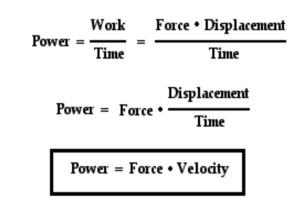
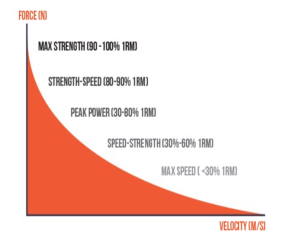
Once strength is increased, each individual athlete must learn how to train with the intent to move or accelerate weight training loads. As indicated above power is a product of force x velocity. If you wish to become more powerful, you must intend to move weight as fast as possible regardless of whether or not the load is heavy or light. Therefore, if you are squatting with a heavy weight, you must try to move the bar up as fast as possible even though the movement speed of the bar might be slow. Your intention to move the weight quickly elicits the neuromuscular response of those muscle fiber types (a.k.a. fast twitch fibers) making them more powerful. Being more focused on every repetition performed is crucial to your power gains. Without the intent to move more explosively you are just working on strength and/or conditioning!

After training with heavier weights and consciously intending to explode concentrically (contracting or shortening the muscle) a more specific methodology of power enhancement may be needed to continually progress more capable or higher level athletes to the next level. Many young aspiring athletes are often not prepared for what is instore for them physically, if they are fortunate enough to attain a collegiate athletic scholarship. Screen Shot 2016-03-15 at 1.59.00 PMThe volume and intensity of a collegiate strength training program, coupled with the complexity of the playbook, work load and ever increasing competition often leads to unforeseen and unfortunate injuries. As a result, the strength coach must analyze the sport and determine the specific muscular contractions, necessary energy systems, and applicable workloads needed for success and development. The needs of a lineman (tremendous starting power), and that of a volleyball or basketball player (great reactive strength) differ, therefore having them constantly train with the same loads and volume would not be beneficial to their specific needs.
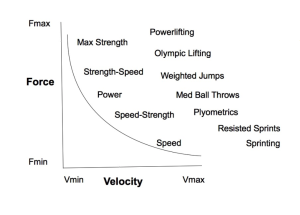
Power development is not the same for all sports. Based on a force velocity curve represented above and below in Figures A and B, the max strength to strength-speed relationship is much more important for a lineman vs. the speed-strength to max speed relationship for that of an outside hitter, point guard or receiver with regard to their individual 1 rep max strength. There is a higher force produced compared to the velocity attained in playing a lineman in football than there would be for a 100 meter sprinter. The velocity of the sprinter would greatly exceed that of the lineman because the force needed to move a lighter weight requires less force and more force is required to move opposing lineman. Both need power, but each need a specific type of power. Whatever the specific requirement, training must then follow to improve those particular qualities of the individual, sport and position. Specificity of training, science based programing, along with certified and experienced coaching is essential to development and results!

Screen Shot 2016-03-15 at 1.59.11 PMA final and often forgotten element of power development is the component of deceleration. Think of a volleyball player who is rushing up preparing to receive a set, as they approach their take off point momentum is trying to carry them into the net and over the line. If they have the ability to quickly stop and redirect their downward and forward momentum in the opposite direction they will have more success in producing lift (jumping) and hitting the ball toward its intended destination. Training the ability to quickly stop momentum (depth drop; lateral push squat, etc.), in coached biomechanically safe positions, is important in a variety of sports and activities. Learning how to decelerate quickly and reverse direction will increase vertical jump height as well as cutting ability. 
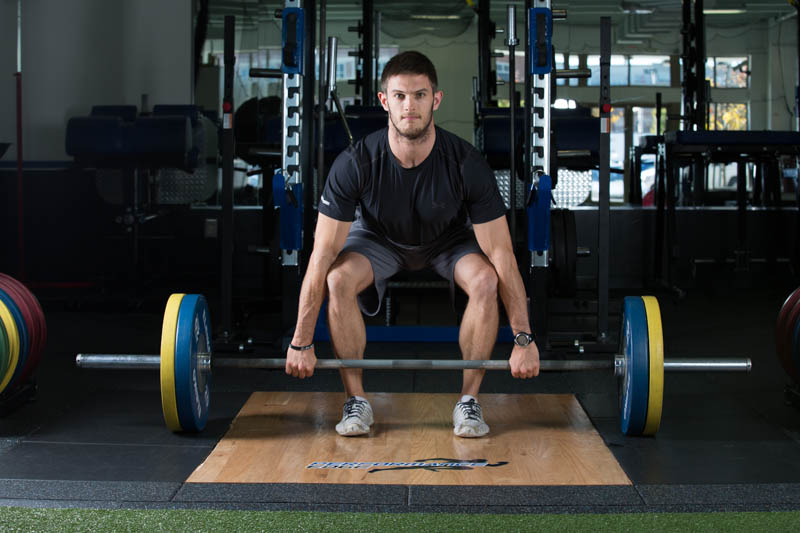
Achieving your best takes more than just being active and staying fit. Find a quality sports training program that focuses on your specific needs as an individual, the sport you are playing, or plan to play, and also what position or event you compete. Not all programs are the same and if you want results quality does not come in a can. Always remember, you get what you pay for!

By: David F. Mikel, CEO, Performance Director – Performance Edge

Champions are made in the off-season!


Sport-Specific In-Season Training: Why It’s Needed

by DAVE MIKEL

Each and every year I hear the same thing from those that have worked hard throughout the off-season; lifting weights, conditioning, speed and agility work, stretching, etc… as soon as their sports season begins they stop working out and say, “I’ll see you after the season’s over”. Why? Look at it this way, you’ve worked hard all season long in preparation for your sport with expectations of having a great season, and then you stop doing what made it all possible.

Pic 7 - S. Hall

The question that every athlete should be asking and seeking expert advice on is, “What should I be doing during the season to maintain all the great gains I made off-season?” The answer has to do with specificity and reduced training volume.

As a full-time strength and conditioning coach in the NFL, college and high school I made sure that our pre-season phase (4-5 weeks) was the most sport and position specific as possible. In addition, I reduced the amount of lower body weight training as a means of tapering. The program was designed this way to enhance performance, and to prevent injury during training camps. In-season training maintains this same philosophy.

These same training principals apply, whether you are a professional athlete, a young amateur athlete, or consistently competing in recreational events. My 15+ years of strength coaching experience at all levels has taught me that in order to efficiently maintain the strength and power you developed in the off-season, the majority of your weight training workouts should be explosive in nature and trained with reduced volume. To better understand this, let’s first look at what explosive weight training means.

Power Training
Power and explosiveness is of high priority in most sports. There are a number of training methodologies that teach power production, but remember whatever exercise you are performing to enhance lower body power, you must consciously intend to explode, be it with light or heavy weight. The intent to move quickly elicits the fast twitch muscle fibers, and the intensity of that intent creates the contraction strength. In other words, if you want to move quickly, and with power, you must try as hard as you are able.

Since the majority of your lifts/training during the in-season should be explosive in nature, you must limit or omit (especially with respect to your lower body) training that is “bodybuilding” in nature. This is where the reduction of training volume is critical.

Reduced Volume
Volume refers to the total number of sets and reps performed for each exercise. Bodybuilding (muscle-building) protocols dictate that a moderate number of repetitions/set be performed (8-12). Multiple sets within this repetition range are also performed at a very high intensity of effort. The problems associated with using bodybuilding methods during the season are: 1) it is very fatiguing, and 2) not specific to the types of muscular contractions required in your sport. Instead, perform a lower volume of reps/set (2-6), and total sets (2-4) for each lower body exercise; two exercises at most per session. Perform these exercises with a moderate amount of weight and intend to explode on every rep of every set to enhance power, even if the weight feels heavy. Explosively performing a lower volume of training will not only keep you strong but maintain the lean body mass that you have achieved during the off-season.

When I tested the NFL, collegiate, and high school players during the season, I found that we were very effective in maintaining strength and lean body mass when our players trained in the manner described above. While working with Mark Nemish, the strength and conditioning coach for the Washington Capitals, electronic devises we used that measured power, also showed that we maintained lower body explosiveness very effectively throughout the season. Training with a reduced volume, but with explosive contractions, will also serve to conserve your energy for more important aspects of your in-season: skill training, injury pre-habilitation, and performance.

Skill Training:
Having had the opportunity to have played and work at various levels of prep, collegiate and professional sports, I have had the privilege to learn from several wise and extremely knowledgeable coaches. As a strength coach, I have several functions I am tasked with, but the one thing Sam Rutigliano (former Head Coach of the Cleveland Browns and Offensive Coordinator for the Barcelona Dragons and Scottish Claymore of the NFL Europe League) impressed upon me was the notion that during the season, the players must be ready to play the game. Thus, by following the training guidelines outlined above, you will give yourself a much better chance to be recovered for your games and practices than if you employ muscle building methods. It is during games and practices that your skills must be showcased and honed. Remember, you can’t play the game in the weight room!

Finally, it is a great time during the season to work on injury prevention strategies specific to your sport and your own history of injuries. Many of our players receive specialized exercises addressing their specific weaknesses during the year. Rotator cuff strengthening for weak shoulders or specialized abdominal workouts for those with low back problems are examples of these specialized injury pre-habilitation protocols.

In summary, in-season training for your sport is crucial in terms of maintenance and injury prevention. Remember, reduce the volume of your strength training work and perform the majority of your lower body exercises in an explosive fashion. This will aid in maintaining strength, lean body mass, and explosiveness while sparing your energy for more important methods of preparation and competition.

Have a great season, and remember quality over quantity! Stay Strong!